Flood & Storm Damage Restoration Easton, CT
Reservoir Runoff, Flooding & Cat 3 Water 60-Minute Emergency Response, Direct Insurance Billing
 IICRC Certified
 Eco-Friendly Solutions For Healthier Spaces
Reviewed by Marvin Riveira·Licensed & Insured In CT·Owner-Operated
What Is IICRC S500 §5.3 Flood Damage Restoration?
Flood damage restoration is the IICRC S500-2021 §5.3 documented process for Category 3 black water: full PPE response, controlled demolition of porous materials to sill plate, EPA-registered antimicrobial application per IICRC S520-2024, structural drying to ANSI/IICRC dry standard, and lab-verified post-remediation clearance before reconstruction. Reservoir watershed runoff, Mill River overflow, septic backup, and surface floodwater arrive as Category 3 on contact regardless of how clear the water looks.
In Easton, CT, Green Restoration sequences every flood scope: 60-minute dispatch, FLIR thermal mapping and Tramex CME 5 moisture verification, truck-mounted Hydramaster extraction, controlled porous demolition, antimicrobial treatment, Phoenix Axial drying monitored daily, and a carrier-ready scope file with NFIP-formatted documentation, base flood elevation reference, and high-water-mark photographs filed within the 60 days NFIP Proof of Loss window.
- IICRC S500-2021 §5.3 aligned
- IICRC S520-2024 antimicrobial protocol
- ASTM E1745 Class I vapor retarder
- ASHRAE 160 humidity targets
- NFIP-formatted scope packet
- FEMA Map Service Center referenced
The Four Layers Of Flood Coverage In Easton
NFIP Building
$250,000
single-family cap
NFIP Contents
$100,000
residential cap
FEMA IA Grant
$43,600
+ $43,600 ONA
SBA Home Loan
$500,000
from 2.875%
Your standard CT homeowners policy excludes flood, surface water, tidal overflow, and wave action. NFIP closes the gap with a 30 days waiting period and a 60 days Proof of Loss deadline. Add $30,000 Increased Cost of Compliance for elevation requirements.
Connecticut average NFIP claim payout was $8,727 in 2025 and the average policy premium runs $1,426/year for roughly $272,799 of coverage (per FEMA NFIP and CT Insurance Department data). This information is general education only, not insurance, legal, or coverage advice. We submit IICRC documentation directly to your insurer. We are not licensed public adjusters and do not negotiate, adjust, interpret your policy, or settle claims on your behalf.
How to clean up after a flood: our step by step first 48 hours guideConditions from the National Weather Service and Open-Meteo.
Trusted by Families in Easton &
Fairfield County
4.9 out of 5, Rated by your neighbors on Google
We discovered mold when removing our pellet stove and called Green Restoration for help. David was very communicative and helpful throughout the entire process. He did the job thoroughly and professionally. Highly recommended!
David Woolner
Mold RemediationI had a fantastic experience with Green Restoration. From start to finish, the team was professional, thorough, and extremely knowledgeable. David came for the initial inspection and took the time to explain the entire process.
Annmarie Gieparda
Mold RemediationWe had mold due to a water leak in our half finished basement. David and his crew did a great job, we were very satisfied. I would highly recommend Green Restoration to anyone.
Tanya
Water DamageI needed my entire condo completely cleaned after a soot blow back. Green Restoration was top shelf! So thorough and professional. Thank you so much!
Jacki Hornish
Fire & Soot CleanupMore Green Restoration Services in Easton
The same local Green Restoration team covers all of these across Easton. One number for every emergency and every cleanup.
What Does Flood & Storm Damage Restoration In Easton, CT Involve?
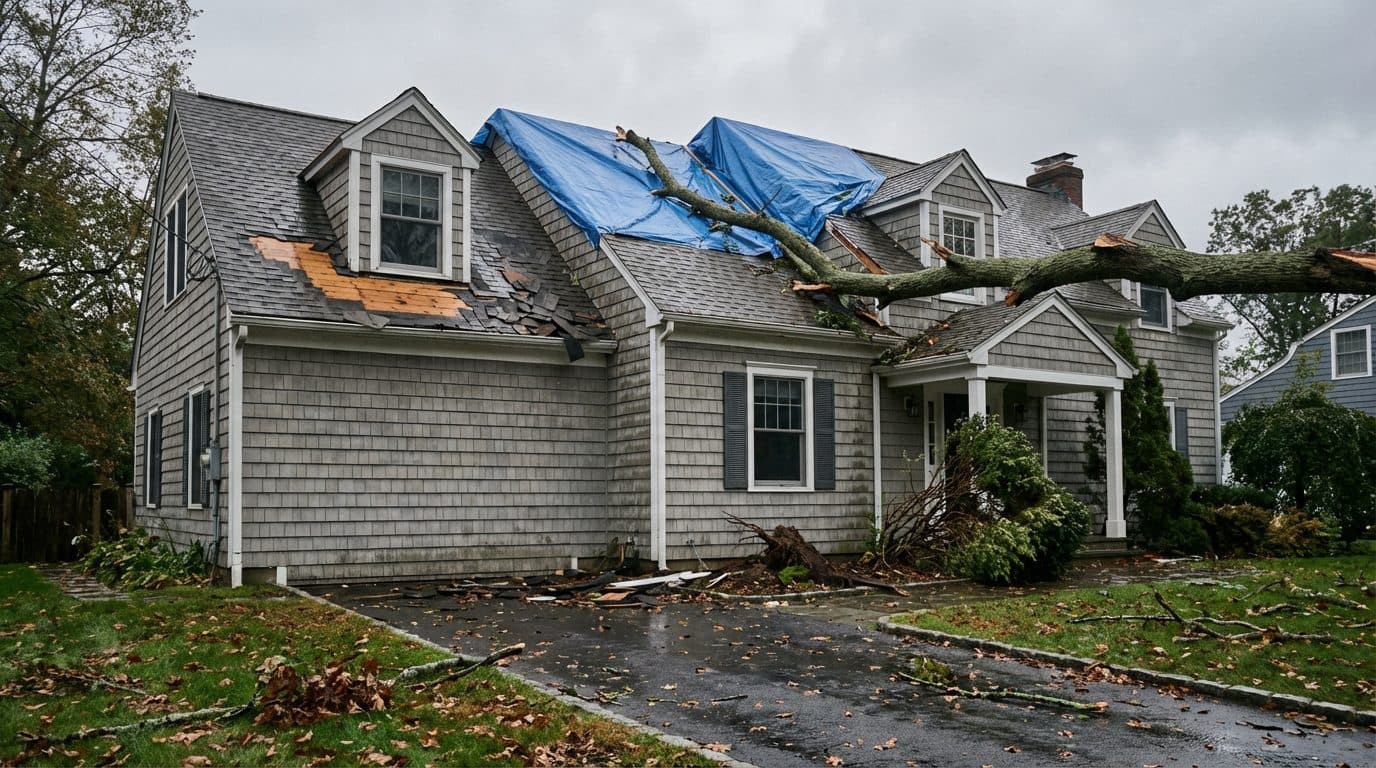
Flood and storm damage restoration in Easton, CT covers two emergencies under one IICRC S500-2021 5.3 response: storm work (emergency roof tarp-up, fallen-tree and wind impact, board-up) and Category 3 floodwater (reservoir watershed runoff, Mill River overflow, flash flooding, septic backup, basement flooding). Green Restoration extracts, decontaminates, structurally dries, and documents the loss for your NFIP and homeowners carriers, and is on site within 60 minutes across Easton, 24/7.
Easton Flood History
The August 18-19, 2024 severe storms dropped extreme rainfall on inland Fairfield County, triggering historic flash flooding, landslides, and mudslides that overwhelmed wooded-town basements far from any river. It is the inland flood event Easton homeowners should plan for, and the reason properties in reservoir-watershed and Mill River corridors need NFIP flood coverage separate from a homeowners policy.
Source: August 18-19, 2024 CT severe storms and flooding (FEMA DR-4820-CT, Fairfield County designated). Photo: Representative regional inland flood photo.
- FEMA Designation
- Zone X + AE
- Primary Flood Vectors
- Aspetuck Reservoir watershed runoff, Mill River overflow, flash flooding, septic backup
- NFIP Coverage Caps
- $250K building · $100K contents
- Response
- 60 min, 24/7
Verify Your Flood Zone
(203) 742-0492Complete Flood & Storm Damage Restoration In Easton, CT
One emergency response for both: storm cleanup, roof tarp-up, and fallen-tree removal, plus flood extraction for reservoir watershed runoff, flash flooding, septic backup, and basement flooding. Every loss documented for your insurer.
IICRC S500 5.3 Category 3 Black Water Extraction
Sport Hill Road, Old Redding Road, and Aspetuck corridor properties hit by reservoir watershed runoff, septic surcharge, or surface floodwater require Category 3 protocol per IICRC S500-2021 5.3. Full PPE crews in Tyvek and N95 deploy truck-mounted Hydramaster CDS-4.8 extractors. Porous materials get controlled demolition, EPA-registered antimicrobial per S520, and structural framing dried to ANSI/IICRC standard with daily Tramex CME 5 verification.
IICRC S500 5.3 - Tramex CME 5 verified
Emergency Roof Tarp-Up And Board-Up
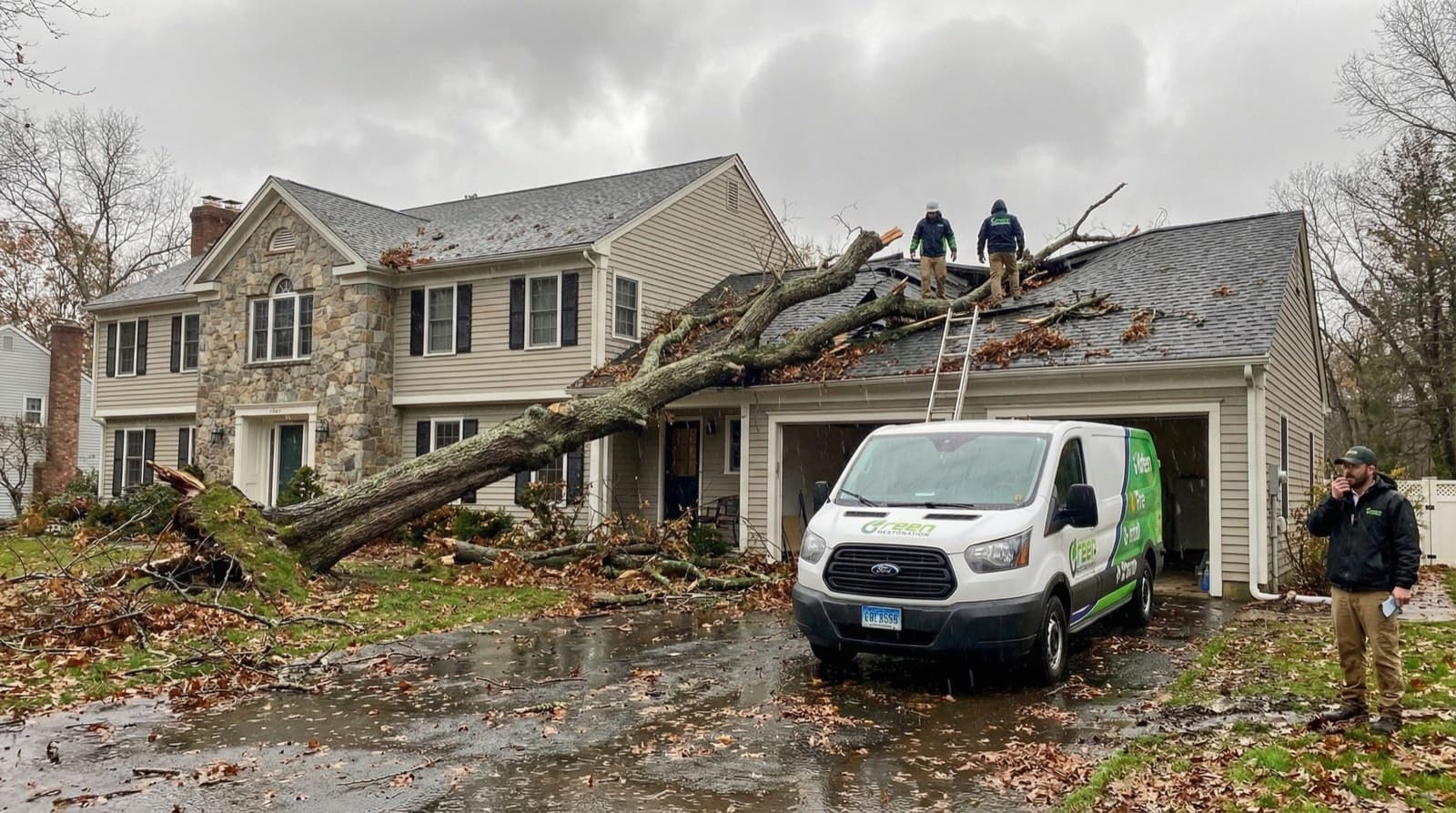
Same-day blue-tarp installation across wind-stripped roofs and fallen-tree impact zones, secured with furring strips and roofing nails, plus emergency board-up of broken windows and breached walls. Weather-tight protection for Easton homes from Sport Hill Road to the Center Road historic stretch after nor'easters, microbursts, and hurricane remnants until permanent repairs begin.
Same-day tarp - Weather-tight seal
Fallen Tree And Wind Impact Response
Complete tree-impact response for the dense oak and hardwood canopy across Easton's deeply wooded estate parcels along Sport Hill Road, Westport Road, and the Aspetuck Trail corridor: debris removal, structural assessment, emergency shoring of compromised framing, and coordination with licensed tree-removal crews. We stabilize the structure first, then move straight into water mitigation where the canopy breached the envelope.
Structural shoring - Crew coordination
Additional Restoration Services
Mill River And Reservoir Watershed Flood Recovery
The Aspetuck Reservoir, Saugatuck Reservoir, and Hemlocks Reservoir watersheds dominate Easton terrain, and the Mill River headwaters drain the southern parcels. Storm runoff channels downhill through Sport Hill Road and Old Redding Road wooded lots into below-grade crawl spaces and basements during nor'easters and spring snowmelt. We trace the runoff path, extract with Hydramaster CDS-4.8 units, and dry framing with Phoenix Axial movers per S500 13.
Flash Flooding In Steep Wooded Terrain
Easton's steep, deeply wooded terrain sheds rainfall fast, sending flash-flood pulses down Sport Hill Road, the Aspetuck Trail corridor, and North Park Avenue toward low-lying foundations. After the August 2024 Fairfield County storms, inland flash flooding overwhelmed basements far from any river. We pre-stage extraction and submersible pumps and arrive within 60 minutes before subfloor begins absorbing through the seams.
Sewer And Septic Backup Cleanup
Easton runs on private well and septic with no municipal sewer, so heavy multi-day rain saturates drain fields and forces Category 3 black water back through basement floor drains across Sport Hill Road and Center Road. Cat 3 biohazard mitigation includes EPA-registered antimicrobial per S520-2024, porous material removal to sill plate, and lab-verified clearance documented for Chubb, PURE, AIG Private Client, Travelers, and Liberty Mutual adjusters.
Basement And Crawl Space Flood Restoration
Easton basements and crawl spaces sit below grade on 3-acre wooded lots across the Aspetuck and Saugatuck Reservoir corridors. Sump pump failure during a nor'easter outage, foundation seepage from reservoir watershed runoff, and groundwater intrusion in spring snowmelt all generate Cat 2 to 3 events. Truck-mounted extraction, controlled drywall demolition to sill plate, antimicrobial treatment, and structural drying over 3 to 5 days, documented daily.
Power Outage And Sump Pump Failure Response
Emergency response to sump pump failure during Easton power outages: portable pump deployment, immediate water extraction, and coordination with electrical contractors for backup generator installation. We carry battery and gas-driven pumps on every storm truck so a dead sump during an Eversource outage in the deeply wooded estate stretches does not become a finished-basement loss.
NFIP Claim Documentation For FEMA Zone AE And X
Easton sits mostly in FEMA Zone X, with Zone AE 1% annual chance floodplain mapped along the Mill River corridor and reservoir-watershed channels. Homes in those corridors carry NFIP policies separate from homeowners coverage. We document base flood elevation per FEMA Map Service Center, photograph high-water marks, log Tramex readings on every affected substrate, file Proof of Loss within the 60-day NFIP window, and submit scope packets to Wright National Flood, Allstate Flood, and other Write-Your-Own carriers.
Structural Drying And Post-Storm Mold Prevention
Flood and storm water trigger mold colonization within 24 to 48 hours in saturated Easton framing, hand-hewn-stone farmhouse cavities, and pre-1900 to mid-century housing stock. We dry with Phoenix Axial movers and LGR dehumidifiers by psychrometric calculation, apply EPA-registered antimicrobial per IICRC S520-2024, install HEPA negative-air containment, and verify clearance with independent ACAC sampling before reconstruction.
Aquarion Watershed-Safe Restoration Protocol
Properties along the Aspetuck Reservoir and Hemlocks Reservoir corridors fall inside Aquarion Water Company watershed-protection boundaries. After a flood or storm loss, we apply only EPA-registered antimicrobials approved for reservoir-zone use, with documented lot numbers and application logs for every reservoir-zone job, and coordinate with Eversource for safe panel shutoff where water reaches electrical components.
Reconstruction And Insurance-Ready Repair
Full reconstruction including drywall, paint, flooring, roofing, and finish carpentry by licensed CT contractors, plus period-correct plaster repair on antique farmhouse stock, so you close the claim with one restoration partner from emergency tarp to final walkthrough. Every Easton storm and flood file ships with a complete IICRC scope packet, daily drying logs, and itemized estimate formatted for direct adjuster submission.

Don't Wait For Flood Damage To Get Worse. Every Minute Counts.
Reservoir Watershed Runoff, Septic Backup, And Cat 3 Black Water Specialists For Easton.
Why The Water Category Decides Everything In A Easton Flood
Per IICRC S500-2021 §5.3, every flood loss is classified Category 1, 2, or 3 before scope is signed. Category drives demolition extent, antimicrobial protocol, drying timeline, and what your insurance carrier expects to see in the documentation. Most Easton reservoir watershed runoff, flash flooding, and septic backup arrives as Category 3 from the first moment of contact.
Common Sources
Burst supply line, ice maker overflow, sink overflow
Restoration Protocol
Extract, dry, sanitize. Most porous materials salvageable if dried within 24 to 48 hours.
Drying typically 3 to 5 days
Common Sources
Washing machine discharge, dishwasher overflow, toilet overflow without solids, aquarium leak
Restoration Protocol
Extract, antimicrobial pre-treatment, dry, post-clean sanitize. Saturated carpet pad and porous insulation typically discarded.
Drying typically 4 to 7 days
Common Sources
Septic backup, ground surface floodwater, reservoir watershed runoff, Mill River overflow, toilet overflow with solids
Restoration Protocol
Full PPE response, controlled demolition of porous materials to sill plate, EPA-registered antimicrobial per IICRC S520-2024, post-treatment clearance sampling.
Restoration typically 7 to 14 days including reconstruction
Why this matters for Easton, CT
Wind-driven rain that enters through a roof breach can stay Category 1 if treated within hours.
The same water becomes Category 2 after 48 hours in a warm cavity, and Category 3 once it contacts standing sewage, soil, or decomposing organic material.
In an Easton loss, reservoir watershed runoff and Mill River overflow are Category 3 on arrival per S500 5.3 because surface floodwater carries soil bacteria, private septic-field contaminants, and decomposing organic debris from the wooded terrain regardless of how clear it looks at the high-water mark.
Our Flood & Storm Damage Restoration Process In Easton, CT
From the first call to final walkthrough, every step is documented, insured, and owner-supervised.
How would you like
to start?
Common range across Category 1 clean rainwater intrusion through Category 3 septic backup and flash-flood black water with antique farmhouse preservation scope. Final pricing depends on Tramex on-site inspection.
Get A Price Range In 60 Seconds.
Four quick IICRC S500-aligned questions. Starting figures published on this page. No call required, no email collected before you see the range.
Walk The Loss With The Owner.
Tramex CME 5 + FLIR thermal scope. Free, no obligation. Owner-led on every Easton flood job.
Ranges shown are starting figures only. Final pricing depends on on-site inspection, NFIP zone reference, and carrier coverage. We are not licensed public adjusters.
Why Choose Us In Easton
Owner-led service with 60-minute response, direct insurance billing, and eco-friendly methods across Easton.
60-Minute Emergency Response
IICRC-certified crews arrive within 60 minutes, day or night, every day of the year.
Owner-Operated Local Crew
Every job is personally overseen, from first call to final moisture reading.
Direct Insurance Billing
We bill State Farm, Liberty Mutual, USAA, Farmers, AIG, Chubb, and Safeco directly.
EPA-Registered Antimicrobials
EPA-registered antimicrobials and Safer Choice cleaning products applied per IICRC S500 and S520 standards.
Easton Emergency Utility Lines
Stopping water at the source is step 1 of any water-damage scope. Use these verified Easton lines while our IICRC crew is en route.For life-threatening emergencies (active fire, gas odor, electrical shock), call 911 first.
Water Authority
CT DPH Drinking Water
(860) 509-7333
Town is mostly private wells. Contact CT DPH or a licensed well contractor for emergencies.
Source: portal.ct.gov
Gas Leak
Southern Connecticut Gas
(800) 513-8898
If you smell gas, leave immediately, call 911 first, then this line from a safe location.
Source: soconngas.com
Electric Emergency
United Illuminating
(855) 784-3637
Submerged outlets or wet panel: cut breaker, then call to confirm service drop is safe.
Source: uinet.com
Police (Non-Emergency)
Easton Police
(203) 268-4111
Sewer-backup Cat-3 claims sometimes need a police report. Call dispatch.
Source: eastonct.gov
Numbers verified against public utility and municipal sources. Green Restoration is not affiliated with these agencies. We provide these as a courtesy resource alongside our IICRC water-damage response.
FEMA Flood Zones In Easton, CT
Your FEMA zone decides whether your mortgage lender requires NFIP coverage, what premium tier you pay, and which Base Flood Elevation determines a covered loss. We document zone designation, BFE, and high-water mark on every Easton flood scope so adjusters from Wright National Flood, Allstate Flood, and Write-Your-Own carriers have what they need to approve the claim.
Minimal hazard or 500-year floodplain. Most of wooded inland Easton. ~25% of NFIP claims still come from Zone X.
Affected In Easton
Sport Hill, Silver Hill, Morehouse, Sherwood, most 3-acre wooded estate lots
NFIP optional
1% annual chance floodplain. NFIP required for federally-backed loans.
Affected In Easton
Mill River headwaters corridor, Aspetuck and Saugatuck Reservoir watershed channels
NFIP required
Shallow flooding 1 to 3 feet, ponding near low-lying drainage.
Affected In Easton
Low-lying parcels near reservoir watershed outflow and Mill River channels
NFIP depth-rated
Downhill runoff-prone wooded lots outside the mapped 1% floodplain.
Affected In Easton
Sport Hill Road, Old Redding Road, Aspetuck Trail downhill collection lots
NFIP optional
Zone definitions sourced from FEMA Flood Map Service Center + 44 CFR Part 64. Verify your property zone before any policy renewal.
Where Flood Zones Hit Hardest In Easton
Mill River 1% annual chance floodplain draining the southern parcels
Watershed channels and low-lying drainage near reservoir outflow
Downhill runoff collection on steep wooded estate lots
Upland minimal-hazard wooded estate interior
Sourced from FEMA Map Service Center FIRM panels for Easton, CT. Verify your property zone before policy renewal.
The Anatomy Of A Flood Damage Restoration
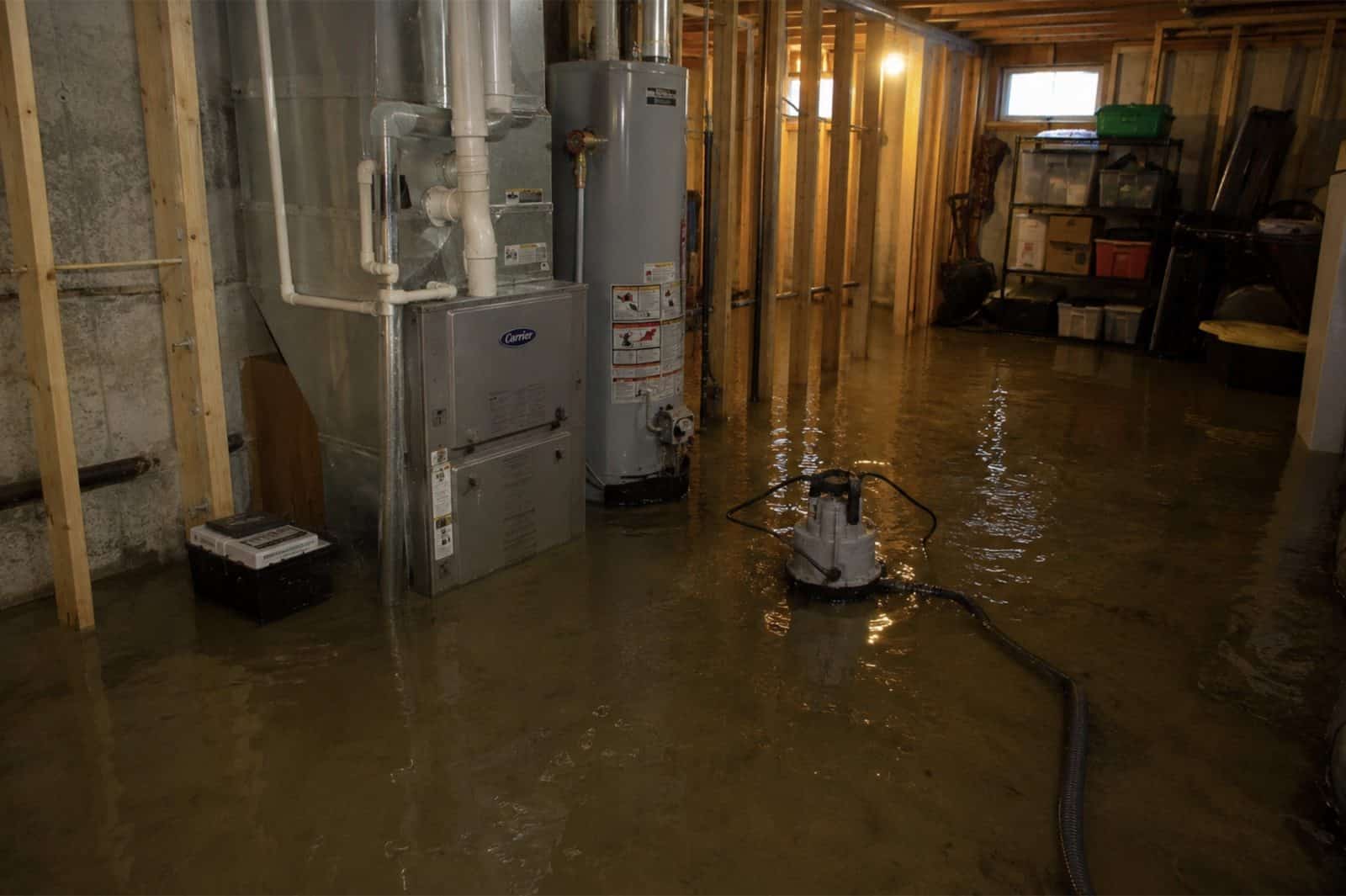
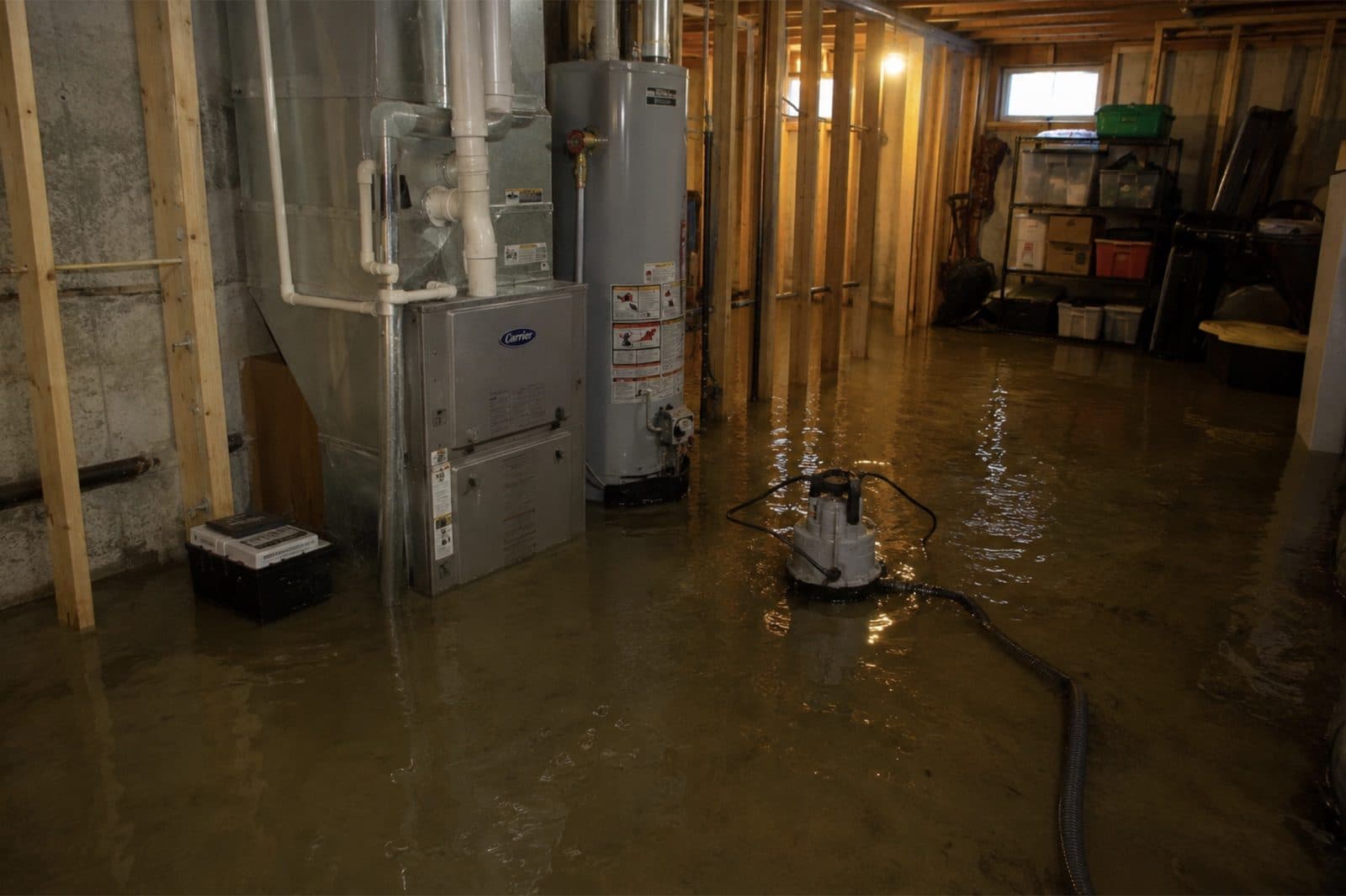
Every flood loss looks different, but the protocol does not. Below is what a typical Category 2 to 3 basement flood looks like once extraction starts and how Green Restoration sequences the scope. Photos are representative of common Fairfield County flood scenes and are not necessarily from a specific Easton property.
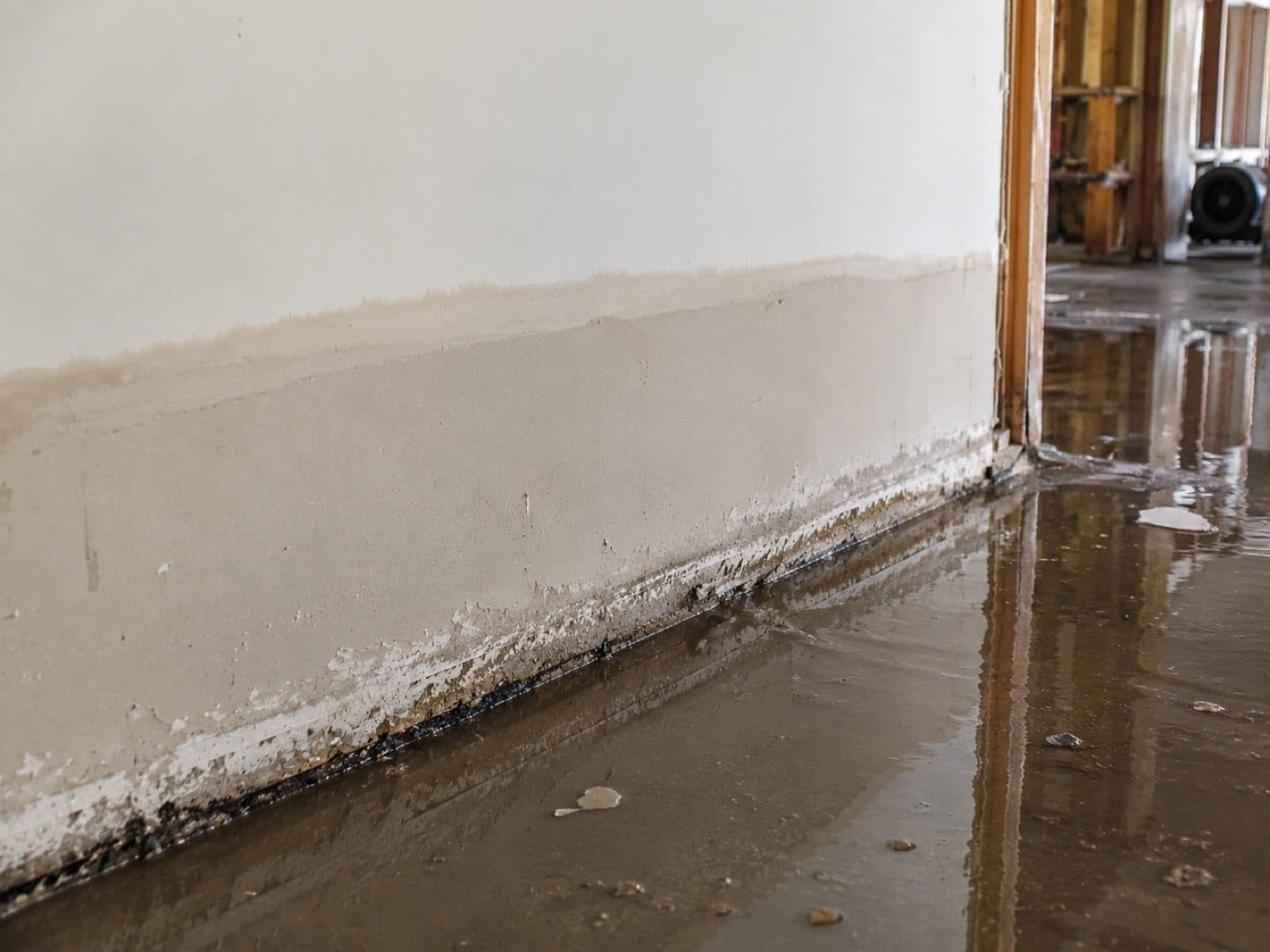
What A Category 3 Flood Loss Looks Like
The horizontal line marks where standing water sat for hours. Drywall below the line is saturated, plaster behind it has wicked cavity moisture, and porous insulation has begun mold colonization within 24 to 48 hours.
Most Common Loss
Basement Cat 2 to 3
Sump pump failure during a storm outage, municipal sewer backflow during sustained rain, and river overflow into below-grade rooms are the flood losses we are called to most often across Fairfield County. Plaster, fieldstone, and slow-drying cavities trap moisture beyond surface readings.
Typical scope $3,500 to $12,000
Inland Variant
Reservoir Watershed Runoff
Storm runoff from the Aspetuck, Saugatuck, and Hemlocks Reservoir watersheds and Mill River headwaters channels downhill through Sport Hill Road and Old Redding Road wooded lots into below-grade basements and crawl spaces during nor'easters and spring snowmelt. Septic-field saturation compounds the load on private-septic parcels.
Typical scope $6,000 to $30,000+
Typical Timeline
7 to 14 Days
Days 1-2: PPE extraction and porous demolition to sill plate. Days 2-4: EPA-registered antimicrobial per IICRC S520-2024. Days 4-8: Phoenix Axial structural drying with daily Tramex CME 5 verification to ANSI/IICRC dry standard. Days 8-14: ACAC clearance + reconstruction.
Daily moisture logs filed with carrier
Documentation
NFIP + Homeowners
Base flood elevation reference from FEMA Map Service Center, timestamped high-water-mark photographs from multiple angles, daily Tramex moisture readings, and a complete IICRC S500 scope packet formatted for both your Write-Your-Own NFIP carrier and your homeowners adjuster.
60-day NFIP Proof of Loss window
Recent Anonymized Easton Restorations
Sport Hill Road
Aspetuck watershed runoff
- 16 in. wooded-lot basement
- 11 days to ANSI/IICRC dry
- NFIP file accepted
Old Redding Road
Sustained rain + septic surcharge
- Finished basement + bath
- 9 days to S520 clearance
- Sewer endorsement claim paid
Mill River corridor
Mill River headwaters overflow
- 14 in. crawl space silt
- 5 days to ASTM E1745 wrap
- Homeowners + NFIP split file
Snapshots are anonymized real Easton jobs. Photos representative of Category 2 to 3 basement flood scenes. Scope ranges typical of inland Fairfield County losses; reservoir watershed and septic-backup jobs trend higher due to porous demolition and drain-field decontamination.
What To Do After Flooding In Easton, CT
Reservoir watershed runoff, flash flooding, and septic backup all require different handling than a clean burst pipe. Follow these IICRC S500 5.3 protocols while waiting for our crews.
What To Do Immediately
In flash flooding or sustained runoff events, leave the lower level immediately. Do not return until utility and local emergency services confirm safe access.
NFIP and homeowners adjusters require timestamped images of the highest visible waterline. Capture from multiple angles before any cleanup begins.
If the breaker panel is dry and reachable without standing in water, shut off main power. If the panel is wet or submerged, call Eversource emergency line first.
Reservoir watershed runoff, Mill River overflow, and septic backup are Category 3 by IICRC S500 5.3. Wear PPE, do not enter without N95 + gloves + eye protection.
Federal flood insurance policies require a signed Proof of Loss within 60 days of the event. We document the scope and provide the file your carrier needs.
Our IICRC-certified team arrives in Easton within 60 minutes with truck-mounted extractors, PPE crews, and antimicrobial supplies on board.
What NOT To Do
Submerged outlets, downed lines, and contaminated water create electrocution and infection risk. Wait for utility shutoff confirmation and professional PPE.
Consumer wet-vacs cannot handle Category 3 volume or biohazard contamination. Only truck-mounted extractors and submersible pumps rated for solids are safe for flood water.
Running mechanical systems through flood-contaminated zones spreads contaminants and risks the equipment. Have it inspected before restarting after a basement flood.
NFIP and homeowners adjusters require an inventory before contents leave the property. We pack out, document, and store before disposal decisions are made.
Raw sewage and drain-field water carry pathogens that pose respiratory and contact-exposure risk. Stay out of affected zones until professional containment is set up.
Mold colonization begins within 24 to 48 hours of flood saturation. Every additional day in Easton humidity multiplies remediation scope and claim cost.
The Flood-Control System Behind Easton
Easton's flood risk profile is shaped by the reservoir watersheds, river headwaters, and wooded terrain that sit between rainfall and below-grade foundations. Understanding what channels runoff and where the system has limits helps adjusters scope a covered loss and helps homeowners read their NFIP zoning correctly. Below are the named water-management assets that touch Easton and the surrounding Fairfield County drainage basin.
Aspetuck Reservoir + Dam
Aquarion Water Company
Public-supply reservoir and dam on the Aspetuck River draining Easton's central terrain. Watershed runoff during heavy rain channels downhill into Sport Hill Road and Westport Road wooded estate parcels.
Saugatuck Reservoir + Dam
Aquarion Water Company
Large public-supply reservoir along Easton's northern border. Watershed seepage pushes groundwater into crawl spaces along Old Redding Road and North Park Avenue during spring thaw and tropical systems.
Hemlocks Reservoir
Aquarion Water Company
Reservoir-watershed-protection corridor where restoration work requires reservoir-zone-approved antimicrobials and documented application logs after a flood loss.
Mill River Headwaters Drainage
Town of Easton + CT DEEP
Mill River headwaters draining Easton's southern parcels toward Fairfield. The mapped FEMA Zone AE 1% annual chance floodplain follows this corridor and overflows during sustained rain.
Flood Or Storm Emergency In Easton? We Dispatch In 60 Minutes.
Reservoir watershed runoff, flash flooding, septic backup, fallen trees, or wind damage across Sport Hill Road, Old Redding Road, Center Road, and the Aspetuck corridor. Local crews from our Stratford location, ready around the clock.
Flood Damage Restoration Coverage In Easton, CT
Reservoir watershed runoff, flash flooding, septic backup, and Category 3 black water cleanup for Easton homes and businesses. Inland Fairfield County crews on-site within 60 minutes from our Stratford location across all 14 neighborhoods.
Green Restoration provides IICRC S500-certified flood damage restoration in Easton, CT, with deep coverage across neighborhoods most exposed to Aspetuck Reservoir watershed runoff, Mill River headwaters overflow, flash flooding in wooded terrain, and private septic backup events.
Sport Hill Road, Old Redding Road, and Aspetuck Trail wooded estate lots collect downhill watershed runoff; the Mill River headwaters corridor sits in FEMA Zone AE, while most of the wooded interior is Zone X.
With direct access via Routes 25, 59, and 136 from our Stratford location, our IICRC-certified crews respond in 60 minutes, day or night.
As a locally owned company based at 1111 Stratford Ave, Stratford, CT 06615, we know the specific challenges Easton properties face: hand-hewn-stone foundation drying in pre-1900 Sport Hill Road and Center Road farmhouse stock, private well and septic dependency with no municipal sewer, reservoir-zone-approved antimicrobials inside Aquarion watershed boundaries, and NFIP base flood elevation documentation required for Wright National Flood and Allstate Flood policies, and the IICRC S500 §5.3 Category 3 protocol every flood requires on arrival.
We submit IICRC-standard documentation directly to your insurer. We are not licensed public adjusters and do not negotiate claims on your behalf.
Flood Emergency In Easton?
Category 3 dispatch and NFIP documentation, 24/7/365.
(203) 742-0492IICRC Certified Firm · Licensed & Insured · CT HIC.0702252 · All Insurance Accepted
See typical Easton flood damage pricing in 60 seconds. Category 1 to 3.
All Towns Served By Green Restoration Of Fairfield County From Our Stratford Location For Emergency Flood Damage Restoration & NFIP Documentation.
Free On-Site Assessment
Not sure what you are dealing with in Easton?
We establish the scope on site, before anything is quoted.
(203) 742-0492How Easton's Inland Geography Shapes A Flood Scope
Easton is the most rural town in Fairfield County, a zoning-restricted wooded suburb with no commercial center, no coastline, and no municipal water or sewer. The Aspetuck, Saugatuck, and Hemlocks Reservoir watersheds dominate the terrain, with the Mill River headwaters draining the southern parcels toward Fairfield. Storm runoff channels downhill through Sport Hill Road, the Aspetuck Trail corridor, and Westport Road wooded estate lots into below-grade basements during nor'easters, spring snowmelt, and inland flash-flood events like the August 2024 Fairfield County storms. Every parcel runs on private well and septic, so drain-field saturation during sustained rain forces Category 3 black water back through floor drains.
Easton housing stock spans pre-1900 hand-hewn-stone farmhouses through mid-century and post-1980 estates, with hand-hewn-stone foundations and reservoir-zone watershed-protection boundaries that all behave differently under Category 3 water loss than coastal construction. Knowing the difference matters when scoping an emergency.
24/7 Flood & Storm Damage Response In Easton, CT
Our IICRC-certified flood crew is staged at our Stratford location and dispatched to Easton Category 3 emergencies around the clock. Most reservoir watershed runoff, flash-flood, and septic backup calls are on site within the hour with full PPE and Hydramaster extractors.
Calls answered around the clock by our team or AI assistant, transferred to a human on flood emergencies. Hydramaster trucks dispatch from our Stratford location with full PPE crews ready within the hour across Easton and Fairfield County.
Every flood job follows IICRC S500-2021 5.3 and S520-2024: full PPE extraction, controlled porous demolition to sill plate, EPA-registered antimicrobial, structural drying with daily Tramex CME 5 verification, and lab-verified ACAC clearance before reconstruction.
We submit IICRC S500 documentation, base flood elevation reference, high-water-mark photos, and itemized estimates directly to NFIP Write-Your-Own carriers (Wright National Flood, Allstate Flood) and homeowners carriers (Chubb, PURE, AIG Private Client, Travelers, Liberty Mutual, State Farm). We are not licensed public adjusters.
Federal courts strictly enforce the 60-day NFIP Proof of Loss deadline. Every Easton flood project documented with timestamped photo logs, daily moisture readings, FEMA Map Service Center zone reference, and a complete scope packet ready for filing well within window.
About Green Restoration In Easton, CT

Your Easton Flood & Storm Damage Specialists Since 2014
Green Restoration provides IICRC S500 5.3 flood damage cleanup and structural drying for homes and businesses in Easton, CT. Our protocol focuses on Category 3 black water extraction, controlled porous demolition, EPA-registered antimicrobial per S520-2024, and full NFIP-formatted documentation. We work with property owners, NFIP Write-Your-Own carriers, and homeowners insurers to document scope clearly, log moisture daily, and restore affected areas to ANSI/IICRC dry standard before reconstruction begins, using reservoir-zone-approved products inside the Aquarion watershed corridors.

“As the local co-owner, I lead a team with 35 combined years in restoration, and inland Easton flood work is where that experience matters most. Every Easton flood scope gets my direct oversight because Aspetuck Reservoir watershed runoff, Mill River overflow, and private septic backup all behave differently than a clean burst pipe, and the documentation has to match what NFIP adjusters expect to see. We don't cut corners, we don't upsell, and we file scope packets that close claims, not stretch them.”
How Much Does Flood Damage Restoration Cost In Easton, CT?
Pricing depends on IICRC S500 5.3 water Category, antique farmhouse preservation scope, and reconstruction extent. Most inland Easton claims settle in the Category 2 to 3 range from $6,000 to $30,000 plus due to porous demolition and drain-field decontamination.
Septic + Flash Flood
$8,000 to $50,000+
Septic backup, reservoir watershed runoff, flash-flood black water, porous demolition on Sport Hill Road + Old Redding Road parcels
River Overflow
$3,500 to $12,000
Mill River headwaters overflow, surface ponding, light silt
Clean Rainwater
$1,500 to $4,500
Rainwater intrusion through wind-created opening, treated within hours
Final cost depends on water Category, affected square footage, drying duration, hand-hewn-stone foundation cavity drying on antique farmhouse stock, porous demolition scope to sill plate, private septic-field decontamination, and NFIP base flood elevation requirements during reconstruction. Use the calculator above for a personalized Easton estimate.
Flood Damage Restoration FAQs
Clear, honest answers about NFIP, FEMA Individual Assistance, Category 3 black water, septic backup endorsements, and Easton inland flood claim documentation.
Only with the right endorsement, and only up to a cap. Standard Connecticut HO-3 and HO-5 policies exclude water that backs up through drains or a failed sump pump, and they exclude flood entirely. A water backup and sump overflow endorsement adds it back, but carriers cap it: State Farm, Allstate, and Liberty Mutual commonly write $5,000 limits, with buy-up tiers to $25,000 or more through high-value carriers like Chubb, AIG Private Client, and PURE. That cap is the most common coverage gap we see on Easton basement losses, because a finished lower level on Sport Hill Road or in the Aspetuck Reservoir corridor can exceed the limit fast.
Flood from reservoir watershed runoff, Mill River overflow, or flash flooding is never covered by a homeowners policy or this endorsement, it requires a separate NFIP flood policy. This information is general education only, not insurance or coverage advice.
Standard Connecticut homeowners policies (HO-3 and HO-5) explicitly exclude flood and surface water whether driven by wind or not. Aspetuck Reservoir watershed runoff, Mill River headwaters overflow, flash flooding in Easton's steep wooded terrain, and external floodwater all require a separate NFIP policy through a Write-Your-Own carrier like Wright National Flood, Allstate, Liberty Mutual, or USAA. Connecticut also enforces the anti-concurrent causation clause, which is why mixed wind-and-water claims often pay less than homeowners expect. We document the loss and submit IICRC-standard scope packets to both your homeowners carrier and your NFIP carrier. We are not licensed public adjusters and do not negotiate claims on your behalf.
NFIP caps single-family residential coverage at $250,000 building and $100,000 contents under the Stafford Act. An additional $30,000 Increased Cost of Compliance benefit is available when local code requires elevation, relocation, or floodproofing during reconstruction. Building and contents carry separate deductibles ranging from $1,000 to $10,000. NFIP has a 30-day waiting period before coverage begins, so post-storm enrollment will not cover the event that prompted it. Connecticut average premium runs $1,426 per year for roughly $272,799 of coverage. NFIP also restricts basement coverage to mechanical systems, unfinished drywall, and cleanup.
Finished basement contents, walls, floors, and ceilings are not covered, a real exposure for the finished lower levels common in Easton estate stock along Old Redding Road and the Aspetuck corridor.
NFIP requires you to file a signed Proof of Loss with your Write-Your-Own carrier within 60 days of the date of loss, and federal courts enforce this deadline strictly. One day late is denial grounds. The Proof of Loss documents the extent of damage, repair scope, replacement cost, and includes photo evidence plus contractor estimates. Green Restoration provides timestamped photo logs, IICRC S500 moisture readings, base flood elevation reference from FEMA Map Service Center, and a complete itemized scope formatted for direct adjuster submission so you meet the deadline with a defensible file.
IICRC S500-2021 5.3 classifies water by contamination. Category 1 is clean supply line water from a burst pipe or well-pump pressure tank, with most porous materials salvageable if dried within 24 to 48 hours. Category 2 is gray water from washing machines, dishwashers, or toilet bowl overflow without solids, requiring antimicrobial pre-treatment and removal of saturated carpet pad and porous insulation. Category 3 is black water including septic backup, surface floodwater, reservoir watershed runoff, and toilet overflow with solids. Category 3 requires full PPE response, controlled demolition of porous materials to sill plate, EPA-registered antimicrobial per IICRC S520-2024, and post-treatment laboratory clearance before reconstruction begins.
Reservoir watershed runoff and Mill River overflow are Category 3 on arrival because surface floodwater carries soil bacteria, septic-field contaminants, and organic debris regardless of how clear it looks at the high-water mark.
Mostly Zone X, with Zone AE along the reservoir and river corridors. Easton is a deeply wooded inland town, so most of the 06612 sits in FEMA Zone X (minimal hazard or 500-year floodplain) rather than a coastal high-hazard zone. FEMA maps Zone AE (1% annual chance floodplain with established base flood elevation) along the Mill River headwaters corridor and the channels draining the Aspetuck, Saugatuck, and Hemlocks Reservoir watersheds. Sport Hill Road and Old Redding Road wooded estate lots that collect downhill runoff sit in shaded Zone X. There is no Zone VE wave-action mapping in Easton because the town has no coastline. Verify your specific property zone via FEMA Flood Maps at msc.fema.gov before any policy renewal or property purchase.
Our response across Easton is 60 minutes or less, 24/7, dispatching from our Stratford location at 1111 Stratford Avenue up Routes 25 and 59 through the Aspetuck watershed to Sport Hill Road, Old Redding Road, Center Road, the Aspetuck corridor, and the Helen Keller Middle School area. Our crews roll with truck-mounted Hydramaster CDS-4.8 extractors, submersible pumps rated for solids, Phoenix Axial movers, LGR dehumidifiers, full PPE including Tyvek suits and N95 respirators, and EPA-registered antimicrobials staged on every truck. Call (203) 742-0492 any time, day or night, including holidays and during nor'easters. During active storm events our dispatch stays manned around the clock.
Yes, but only up to its scheduled limit. A water and sewer backup endorsement is a rider added to your standard Connecticut homeowners policy because base HO-3 and HO-5 policies do not cover any water or sewage that backs up through drains or sump pump failures. Industry-standard endorsement limits range from $5,000 to $25,000 with buy-up tiers to $100,000 available through high-value carriers like Chubb, AIG Private Client, and PURE that commonly cover Easton estates. Annual premium runs $40 to $250 for $10,000 of coverage.
Because Easton runs entirely on private well and septic with no municipal sewer, drain-field saturation during sustained heavy rain is the most common backup trigger, pushing Category 3 black water into basement floor drains across Sport Hill Road and Center Road.
Flood damage cost in Easton depends on water Category, affected square footage, antique farmhouse preservation scope, and reconstruction extent. Category 2 surface water from reservoir watershed runoff or storm runoff typically runs $3,500 to $12,000 for extraction, antimicrobial treatment, and structural drying. Category 3 septic backup or flash-flood black water runs $8,000 to $50,000 plus, driven by porous material demolition to sill plate, full PPE crew time, lab-verified clearance sampling, and hand-hewn-stone foundation drying on pre-1900 Sport Hill Road and Center Road farmhouse stock. We provide a written estimate on-site after Tramex CME 5 readings confirm the full scope and the affected substrate inventory is complete.
When the President declares a federal disaster, FEMA Individual Assistance can pay up to $43,600 in Housing Assistance plus $43,600 in Other Needs Assistance per household (caps effective for disasters declared on or after October 1, 2024 and CPI-adjusted annually). Connecticut's most recent major declaration was DR-4820-CT for the August 18-19, 2024 severe storms, flooding, landslides, and mudslides, which designated Fairfield, Litchfield, and New Haven Counties for Individual Assistance, the inland flash-flood event that hit wooded Fairfield County towns like Easton hardest.
SBA disaster loans run alongside the FEMA grant: up to $500,000 to repair or rebuild your primary residence, up to $100,000 for personal property, and up to $2,000,000 for businesses at interest rates as low as 2.875% for homeowners with terms up to 30 years.
If water is rising rapidly during flash flooding, move to higher ground and do not return until utility and local emergency services confirm safe access. Photograph high-water marks from multiple angles before any cleanup begins because NFIP and homeowners adjusters require timestamped images of the highest visible waterline. Shut off power at the main breaker only if the panel is dry and reachable without standing in water. Otherwise call Eversource emergency line first. Treat all floodwater and septic backup as Category 3 per IICRC S500 5.3 and do not enter without PPE. Do not run household fans, wet-vac, or HVAC because improper airflow spreads contaminants. Call (203) 742-0492 for IICRC-certified dispatch within 60 minutes.
Green Restoration is an IICRC-certified firm, locally owner-operated with 35 combined years of restoration experience, and equipped specifically for inland Easton flood scenarios. Our trucks carry truck-mounted Hydramaster CDS-4.8 extractors, submersible pumps rated for solids, Phoenix Axial movers, LGR dehumidifiers, Tramex CME 5 moisture meters, FLIR thermal imaging, full Tyvek and N95 PPE, and EPA-registered antimicrobials staged for Category 3 response, including reservoir-zone-approved products for the Aquarion watershed corridors. We document the loss with timestamped photo logs, daily moisture readings, base flood elevation reference from FEMA Map Service Center, and high-water-mark documentation formatted for both your homeowners carrier and your NFIP Write-Your-Own carrier. Direct insurance billing, crews on-site within 60 minutes across Easton 24/7 at (203) 742-0492, and CT HIC.0702252 licensure on every project.
Usually yes, and this is the key difference from flood. Standard Connecticut HO-3 and HO-5 policies generally cover wind, hail, and fallen-tree damage to the structure, including roof, siding, and interior water intrusion through a wind-created opening, subject to your deductible. What they exclude is reservoir watershed runoff, Mill River overflow, and flash flooding, which require a separate NFIP flood policy. After a nor'easter or microburst, a single Easton loss often has both: wind and fallen-tree damage on the homeowners policy and runoff or septic backup on the NFIP policy. We document each cause separately and submit the right scope to the right carrier. We are not licensed public adjusters and do not negotiate claims on your behalf.
Yes. Emergency roof tarp-up and board-up dispatch within 60 minutes across Easton, 24/7, including during active storm events. Crews install weather-tight blue tarp secured with furring strips and roofing nails over wind-stripped or tree-impacted roof sections, board up broken windows and breached walls, and shore compromised framing. For the dense oak and hardwood canopy common across Sport Hill Road, Westport Road, and the deeply wooded estate parcels along the Aspetuck and Saugatuck Reservoir corridors, we handle debris removal and structural assessment and coordinate licensed tree-removal crews, then move straight into water mitigation wherever the canopy breached the building envelope. Photographing the damage before the tarp goes on protects your homeowners claim.
Sump pump failure during an Eversource outage is one of the most common Easton storm losses, especially in below-grade basements on Sport Hill Road, Old Redding Road, and the deeply wooded estate parcels near the reservoir watershed table. If safe, move valuables off the floor and do not enter standing water near electrical outlets or panels. Call us immediately at (203) 742-0492: our storm trucks carry battery and gas-driven portable pumps for extraction without grid power, and we coordinate with electrical contractors on backup generator installation.
The faster the water is out, the lower the odds of Category 2 to 3 contamination and mold colonization, which begins within 24 to 48 hours in saturated framing.

