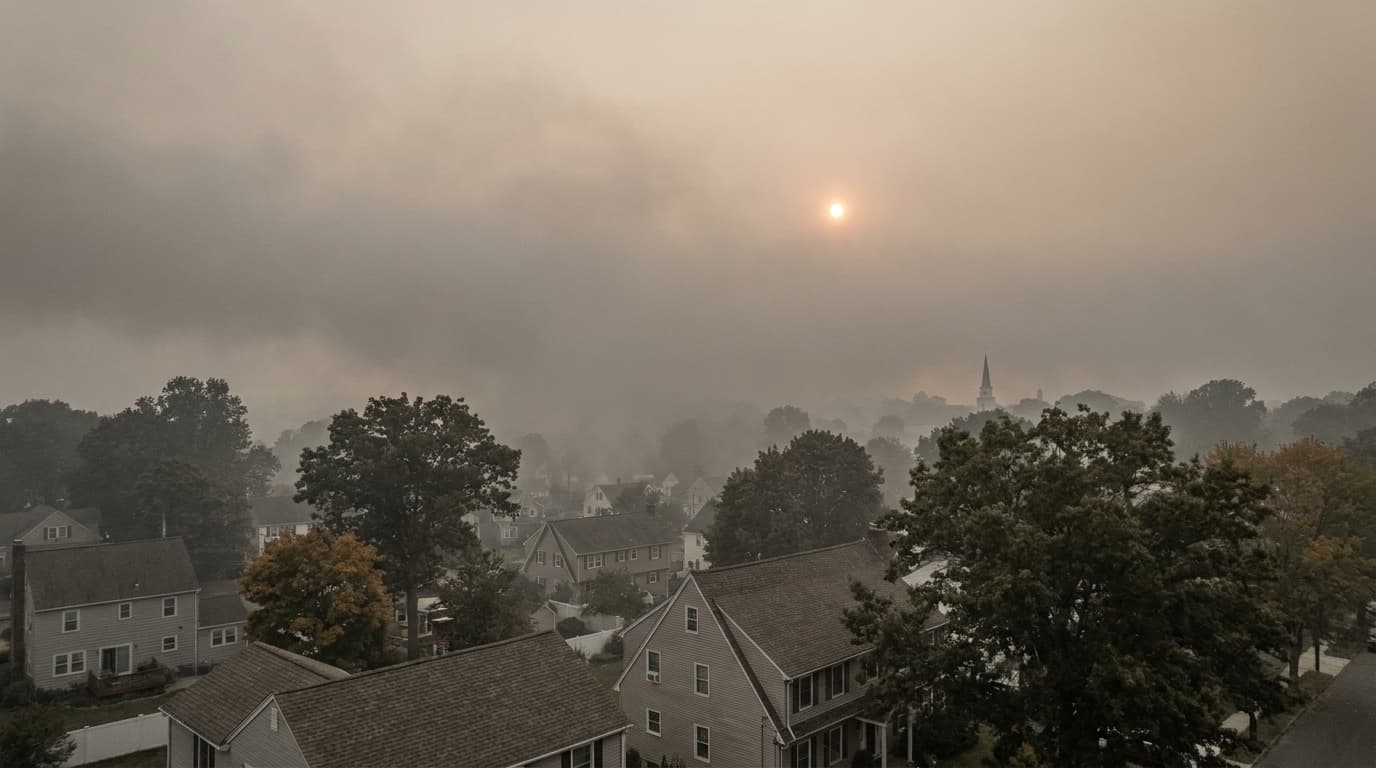
On Thursday, Chicago recorded the worst air quality in its history. Air Quality Index readings above 500 were logged in Toledo, Milwaukee and Detroit, well past the 300 threshold that the index labels hazardous. Air quality alerts covered sixteen states, and more than one hundred million people woke up to a sky the color of weak tea. Connecticut, Westchester and Western Massachusetts sat under those alerts too.
The smoke came from Canada, as it did in 2023, in 2024, and again in 2025. This is the fourth July in a row that boreal fire smoke has reached the Northeast in volume. At some point a pattern that repeats four years running stops being a freak event and starts being a season, and the way you prepare for a season is different from the way you react to an emergency.
Here is the part most coverage skips. Canada has burned roughly 4.7 million acres so far in 2026. That is far below the totals for 2023, which was the worst fire season in Canadian history, and below 2025, which finished second worst. Less land is burning this year, and the air over Chicago was still the dirtiest ever measured there. The amount of fire is not what determines your exposure. The wind is. That is precisely why this belongs on a maintenance calendar rather than a news alert, because you cannot see it coming by watching the fire maps.
At Green Restoration we work on smoke damage across Connecticut, Westchester and Western Massachusetts, and we want to be straight with you about something up front. Wildfire smoke and structure fire smoke are not the same problem, and most homes that smell faintly of campfire this week do not need a restoration company. This article is mostly about what you can do yourself, for very little money, and where the real line sits.
Why This Keeps Happening To Us Specifically
Connecticut is roughly six hundred miles from the nearest Quebec fire. Understanding how smoke covers that distance explains why some summers you barely notice it and others you cannot see the end of your street.
The Fires Are Farther North Than People Assume
The fires driving Northeast smoke events are generally in the boreal forest across Quebec, Ontario and the Prairie provinces. Boreal fires burn deep organic soil as well as standing timber, which produces enormous volumes of smoke relative to the area burned and lofts it high into the atmosphere.
Once smoke reaches altitude it travels as a plume on prevailing winds, and it can stay coherent for thousands of miles. What arrives over New England is not a thin haze that happens to drift down. It is a concentrated river of particulate that a weather pattern has steered directly at us.
It Takes A Specific Weather Setup To Land Here
The June 2023 event, the one that turned the New York skyline orange, happened because a high pressure system near Hudson Bay and a storm system over Atlantic Canada worked together to funnel smoke south. Both systems stalled, which is why the smoke sat over the region for roughly four days rather than passing through in an afternoon.
That is the mechanism to understand. Smoke needs a stalled pattern to pool over a region. When the pattern breaks, usually with a front and rain, the air clears quickly. It is also why forecasting your own exposure from fire acreage alone does not work, and why a modest fire year can still deliver a severe smoke week.
Four Years Is A Pattern, Not A Run Of Bad Luck
2023 was Canada whose fire season burned about 25 million acres, the worst on record. 2024 ranked among the worst, helped along by fires that overwintered in the soil from the previous season and reignited. 2025 finished second worst on record by area burned and carbon emitted, trailing only 2023, and pushed smoke into the Upper Midwest and Northeast in late July and early August. 2026 has burned less, and has still produced the worst air quality Chicago has ever recorded.
Four consecutive years with different fire totals and the same outcome for us tells you the driver is durable. Longer fire seasons and drier conditions in the boreal forest keep loading the atmosphere, and the summer weather patterns that steer plumes toward the Northeast are common. Planning for a smoke week each summer is now the reasonable default.
"Less of Canada burned this year than in 2023 or 2025, and Chicago still had the worst air in its recorded history. Acreage is not the variable. Wind is."
What Smoke Actually Does Inside Your House
This is where honest information matters most, because the gap between what wildfire smoke does and what people fear it does is wide, and that gap is where money gets wasted.
The Pollutant That Matters Is PM2.5
Wildfire smoke is dominated by fine particulate matter measuring 2.5 micrometres or less, which is where the name PM2.5 comes from. For scale, a human hair is roughly 70 micrometres across. These particles are small enough to travel deep into the lungs and, according to health authorities reporting on the current event, small enough for some to enter the bloodstream.
Because the particles are so small, they behave more like a gas than like dust. They move through a building envelope wherever air moves: around window sashes, through recessed lighting, down chimney flues, through bath and dryer vents, and through every gap in an older house that you already knew was there. This is why closing the windows helps but does not solve the problem on its own.
What It Does Not Do
Wildfire smoke arriving after hundreds of miles of travel does not behave like the smoke from a fire in your own building. A structure fire deposits soot and oily residues onto surfaces through heat and proximity, and can drive combustion byproducts into porous materials under pressure. That is a genuine restoration problem, and it is what our fire damage crews are actually trained and equipped for.
Long travelled wildfire smoke, by contrast, mostly loads your filters, leaves a light film on horizontal surfaces in heavy events, and puts a temporary odor into soft furnishings. In the substantial majority of Connecticut homes this week, that is the entire extent of it. If somebody tells you that a smoke advisory means your house now needs professional remediation, be sceptical, and ask them what specifically they observed in your home.
Where The Odor Actually Lives
When a house still smells faintly smoky after the outdoor air clears, the odor is usually held in soft, high surface area materials: upholstery, curtains, rugs, bedding, and the dust that has settled on them. It is also frequently sitting in a loaded HVAC filter that is being blown through every time the system runs.
That second one catches people out. A saturated filter can keep reintroducing odor to the whole house long after the outdoor air is clean. Changing it is often the single change that resolves a lingering smell, and it costs less than a takeaway dinner.
The Under Fifty Dollar Weekend
Almost everything that helps during a smoke event is cheap, available locally, and supported by federal guidance. Here is the sequence, in the order that returns the most benefit for the least effort.
Upgrade The HVAC Filter To MERV 13
The EPA recommends that if you buy a higher efficiency HVAC filter for smoke, you choose one rated MERV 13, or as high a rating as your system fan and filter slot will accept. Most residential furnaces and air handlers will run a MERV 13 without trouble as long as the filter is changed often enough.
The caution is real, though. A denser filter restricts airflow, and on an older or undersized system that restriction can strain the blower. The EPA itself notes you may need an HVAC technician to confirm a MERV 13 or higher filter is compatible with your equipment. If your system is old, if the filter slot is unusually thin, or if you have had airflow complaints before, ask first rather than guessing.
Set The Fan To On, Not Auto
This one is free and most people never think of it. On Auto, the blower only runs when the system is actively heating or cooling, which during a mild smoky stretch might be a small fraction of the day. Air only gets filtered while the fan is turning.
Setting the thermostat fan to On runs the blower continuously, pulling household air through that filter all day instead of occasionally. The EPA specifically recommends running the fan as often as possible to get the most out of the filter. It will add modestly to your electricity use, and during a smoke week it is the highest value setting change available to you.
Change Filters More Often Than The Box Says
Filter intervals printed on packaging assume ordinary indoor air. A smoke event is not ordinary. The EPA advises replacing filters in both HVAC systems and portable air cleaners more frequently than the manufacturer recommends during heavy smoke, and says that if a filter looks heavily soiled when you pull it, you should be changing it more often still.
Practical version: pull the filter and look at it midway through a smoke week. If it has gone grey, replace it, then check again after the event ends. Buying three cheap filters and changing them promptly beats buying one expensive filter and leaving it in for the season.
Build The EPA Box Fan Cleaner If You Need More
The EPA has published research on do it yourself air cleaners built from a box fan and standard furnace filters, developed specifically for reducing wildfire smoke indoors. It is a legitimate, federally studied approach, not a workaround, and it costs a fraction of a commercial air purifier.
If you would rather buy than build, a portable air cleaner sized for the room works too. What matters is that it filters particulate and that the unit is actually rated for the room you put it in. An undersized purifier in a large open plan space is mostly decorative.
Set Up One Clean Room
The EPA recommends creating a clean room, which is a single room you can keep meaningfully cleaner than the rest of the house. Choose a room you can close off, ideally without a fireplace and with few windows, and run a portable air cleaner in it.
This matters most for households with someone who has asthma, heart disease, or another condition that makes poor air riskier, and for infants and older adults. You do not need to purify the whole house. You need one room that is reliably better, and a bedroom is usually the right choice because that is where the longest continuous exposure happens.
Need Restoration Services?
60-minute response across CT, NY & MA. Licensed, insured, free inspections.
What We Will Not Sell You
A restoration company writing about a smoke event has an obvious commercial incentive, so it is worth being explicit about the services we do not think most people should buy right now.
Duct Cleaning, Absent Actual Contamination
The EPA publishes extensive guidance on wildfire smoke and indoor air quality, covering filtration, clean rooms, portable cleaners and do it yourself units. Duct cleaning does not appear in it as a recommended response to a smoke event. That absence is meaningful, and we are not going to paper over it.
Green Restoration follows NADCA standards on duct work, and NADCA itself frames cleaning as a response to demonstrated contamination rather than something to do on a schedule or after any bad air week. If a smoke event coincided with visible debris in your ducts, a system that was already overdue, or an actual fire in the building, that is a different conversation. A hazy sky by itself is not a reason to have your ductwork cleaned, and anyone selling it that way this week is selling the news rather than the need.
Whole House Smoke Remediation For A Faint Smell
If your house smells slightly smoky and the smell fades over a day or two once you ventilate and change the filter, nothing was damaged. That is odor, not deposition, and it resolves on its own.
We would rather tell you that and have you call us in three years for a burst pipe than take a job you did not need. This is the same reason we quote ranges rather than vague promises and put a scope in writing before anyone starts work.
Air Quality Testing As A Default
During an active smoke event, the outdoor AQI already tells you what is in the air, and it is free. Paying for indoor particulate testing to confirm that the smoke outside also got inside rarely changes what you would do about it, which is filter the air and reduce infiltration.
Testing earns its keep when there is a specific unresolved question, for example an odor that persists for weeks after the event with no obvious source, or a health situation where a physician wants documentation. Those are real cases. They are just not most cases.
When It Is Worth Calling Somebody
There is a genuine band where professional help is the right answer. It is narrower than the marketing around these events suggests, and it is worth knowing precisely where it starts.
Visible Deposition On Surfaces
In a severe, prolonged event, particularly in a leaky older house or one where windows were open early on, you can get a fine film settling on horizontal surfaces. If you run a clean white cloth along the top of a door casing or a mantel and it comes back grey, that is deposition rather than odor.
At that point, cleaning method matters. Dry wiping can drive fine particulate into finishes and grind it into upholstery. HEPA vacuuming followed by appropriate wet cleaning, in the right order and with the right chemistry for each surface, is what prevents a light film from becoming a set stain. That sequencing is most of what you are paying for.
Odor That Outlasts The Event By Weeks
If the outdoor air has been clear for two or three weeks, you have ventilated, you have changed the HVAC filter, and the house still smells of smoke, something is holding it. Usually that is soft furnishings, sometimes it is insulation or an attic that took in a lot of unfiltered air, occasionally it is a system that needs looking at.
That is a diagnosable problem and worth a professional assessment, because the answer determines whether you are cleaning textiles, addressing an air pathway, or doing nothing at all.
A Household Member With Real Vulnerability
If somebody in the house has asthma, COPD, heart disease, or another condition that makes air quality a clinical concern, the calculus changes. It becomes worth setting up filtration properly rather than approximately, and worth having somebody confirm your system can carry a higher MERV filter without choking airflow.
We are restoration contractors and not clinicians, so the medical side belongs with your physician. What we can tell you is whether the equipment in your basement will do what you are asking of it.
You Have An Actual Fire Loss
This is the clearest line of all. If there has been a fire in or near your building, wildfire smoke advice does not apply to you. Structure fire residues, protein smoke from a kitchen fire, and heat driven soot are different materials with different behaviour, and they need a proper fire damage response with documentation for your insurer.
We submit our scope of work and supporting documentation directly to your insurance company. We are not licensed public adjusters and do not negotiate claims on your behalf.
Treating Smoke Season Like A Season
The useful shift after four consecutive years is to stop treating this as an emergency you react to and start treating it as a window you prepare for, the same way you already handle gutters in autumn and frozen pipes in January.
A Short June Checklist
Before the window opens each year, three things are worth doing. Confirm what filter size and rating your system takes and whether it will accept MERV 13, asking an HVAC technician if you are unsure. Buy two or three filters and keep them in the basement so you are not hunting for one on the day everybody else is. Decide in advance which room is your clean room and make sure a portable cleaner sized for it is on hand and working.
That is the entire preparation. It takes an hour once a year and it removes essentially all of the scramble.
During The Event
Close windows and doors. Set the thermostat fan to On. Avoid adding indoor particulate while the outdoor air is bad, which means no candles, no wood stove, no frying, and skip the vacuum unless it is HEPA filtered. Check the AQI rather than guessing from how the sky looks, because moderate smoke that you barely notice can still be worth acting on.
Run the clean room if anybody in the household is in a sensitive group. Keep an eye on the filter and change it when it greys rather than when the calendar says so.
After It Clears
Once the front comes through and the air genuinely clears, ventilate properly, change the HVAC filter again, and wash or air out bedding and curtains in the rooms that felt worst. Give it a week.
If the smell is gone, you are finished, and you have spent perhaps forty dollars. If it is not gone, or if you find that grey film on the white cloth, that is the point where a phone call makes sense. Our teams cover Connecticut, Westchester County and Western Massachusetts, and we would far rather talk you out of unnecessary work than sell it to you.