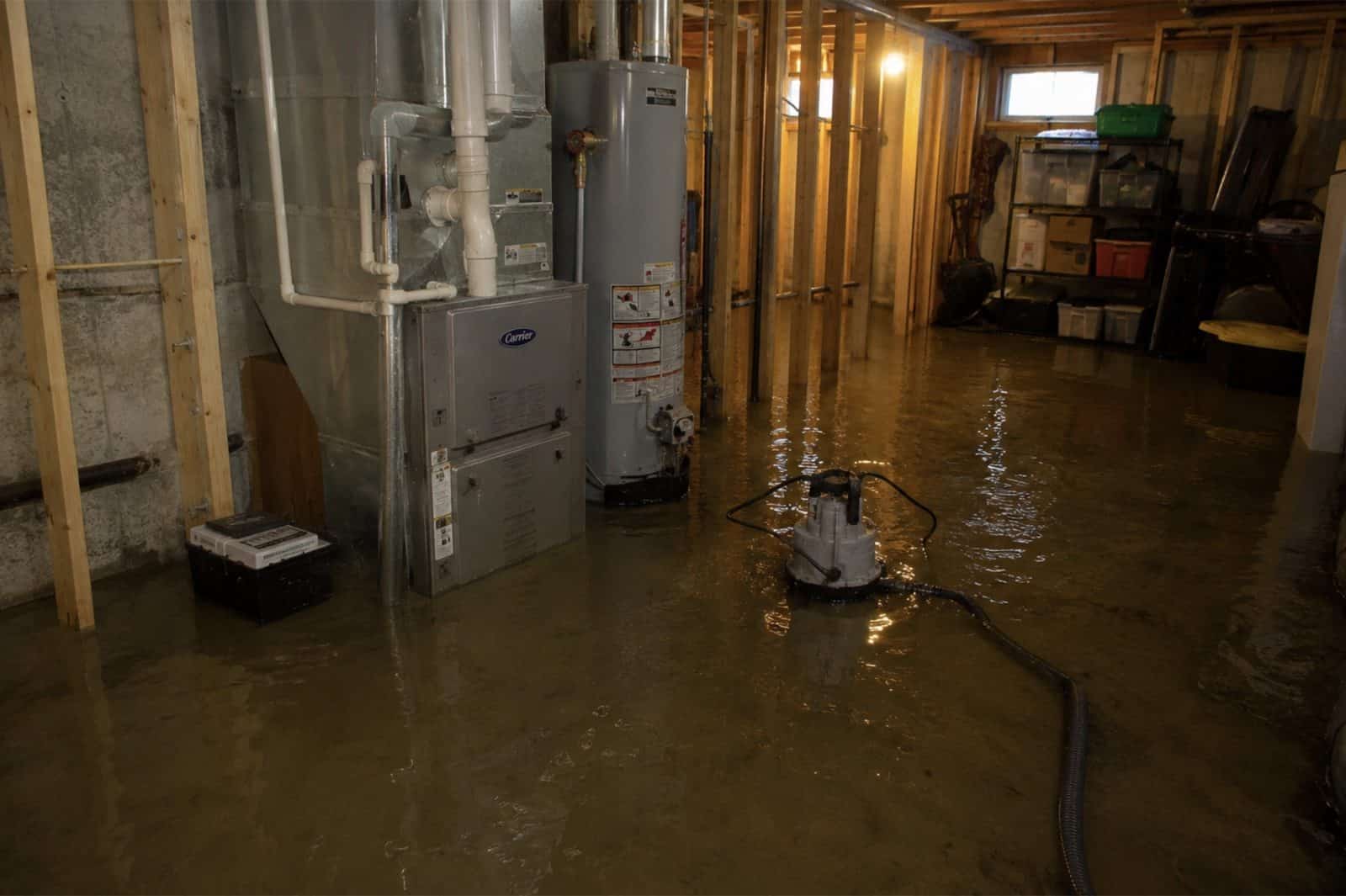
Flood & Storm Damage Restoration Southington, CT
Quinnipiac Floodway, Plantsville And Milldale Flood Response 60-Minute Response, Direct Insurance Billing
 IICRC Certified
 Eco-Friendly Solutions For Healthier Spaces
Reviewed by David Megeneishvili·Licensed & Insured In CT·IICRC AMRT + WRT
What Is IICRC S500 §5.3 Flood Damage Restoration?
Flood damage restoration is the IICRC S500-2021 §5.3 documented process for Category 3 black water: full PPE response, controlled demolition of porous materials to sill plate, EPA-registered antimicrobial application per IICRC S520-2024, structural drying to ANSI/IICRC dry standard, and lab-verified post-remediation clearance before reconstruction. Quinnipiac and Eightmile River water, street runoff and drain backup all arrive as Category 3 on contact, however clear the water looks against a cellar wall.
In Southington, CT, Green Restoration sequences every flood scope: 60-minute dispatch, FLIR thermal mapping and Tramex CME 5 moisture verification, truck-mounted Hydramaster extraction, controlled porous demolition, antimicrobial treatment, Phoenix Axial drying monitored daily, and a carrier-ready scope file with NFIP-formatted documentation, base flood elevation reference, and high-water-mark photographs filed within the 60 days NFIP Proof of Loss window.
- IICRC S500-2021 §5.3 aligned
- IICRC S520-2024 antimicrobial protocol
- ASTM E1745 Class I vapor retarder
- ASHRAE 160 humidity targets
- NFIP-formatted scope packet
- FEMA Map Service Center referenced
The Four Layers Of Flood Coverage In Southington
NFIP Building
$250,000
single-family cap
NFIP Contents
$100,000
residential cap
FEMA IA Grant
$43,600
+ $43,600 ONA
SBA Home Loan
$500,000
from 2.875%
Your standard CT homeowners policy excludes flood, surface water, tidal overflow, and wave action. NFIP closes the gap with a 30 days waiting period and a 60 days Proof of Loss deadline. Add $30,000 Increased Cost of Compliance for elevation requirements.
Connecticut average NFIP claim payout was $8,727 in 2025 and the average policy premium runs $1,426/year for roughly $272,799 of coverage (per FEMA NFIP and CT Insurance Department data). This information is general education only, not insurance, legal, or coverage advice. We submit IICRC documentation directly to your insurer. We are not licensed public adjusters and do not negotiate, adjust, interpret your policy, or settle claims on your behalf.
How to clean up after a flood: our step by step first 48 hours guideConditions from the National Weather Service and Open-Meteo.
Trusted by Families in Southington &
Hartford County
4.9 out of 5, Rated by your neighbors on Google
We discovered mold when removing our pellet stove and called Green Restoration for help. David was very communicative and helpful throughout the entire process. He did the job thoroughly and professionally. Highly recommended!
David Woolner
Mold RemediationI had a fantastic experience with Green Restoration. From start to finish, the team was professional, thorough, and extremely knowledgeable. David came for the initial inspection and took the time to explain the entire process.
Annmarie Gieparda
Mold RemediationWe had mold due to a water leak in our half finished basement. David and his crew did a great job, we were very satisfied. I would highly recommend Green Restoration to anyone.
Tanya
Water DamageI needed my entire condo completely cleaned after a soot blow back. Green Restoration was top shelf! So thorough and professional. Thank you so much!
Jacki Hornish
Fire & Soot CleanupMore Green Restoration Services in Southington
The same local Green Restoration team covers all of these across Southington. One number for every emergency and every cleanup.
What Does Flood & Storm Damage Restoration In Southington, CT Involve?
Flood and storm damage restoration in Southington, CT means extracting floodwater, drying the structure and repairing storm damage under IICRC S500-2021 section 5.3, the standard that classifies contaminated water and sets how it is remediated. Here that covers two emergencies handled by one crew: storm stabilization (emergency tarp-up, wind and fallen-tree impact, board-up) and Category 3 water (Quinnipiac River flash flooding through the floodway, downtown Plantsville street flooding, the Tenmile confluence at Milldale, Misery Brook and ridge runoff off the higher streets, and sewer backup).
Green Restoration extracts, applies EPA-registered antimicrobial per IICRC S520-2024, dries to the ANSI and IICRC standard, and files the loss for your NFIP and Connecticut homeowners carriers. Response across Southington is 60 minutes, 24/7.
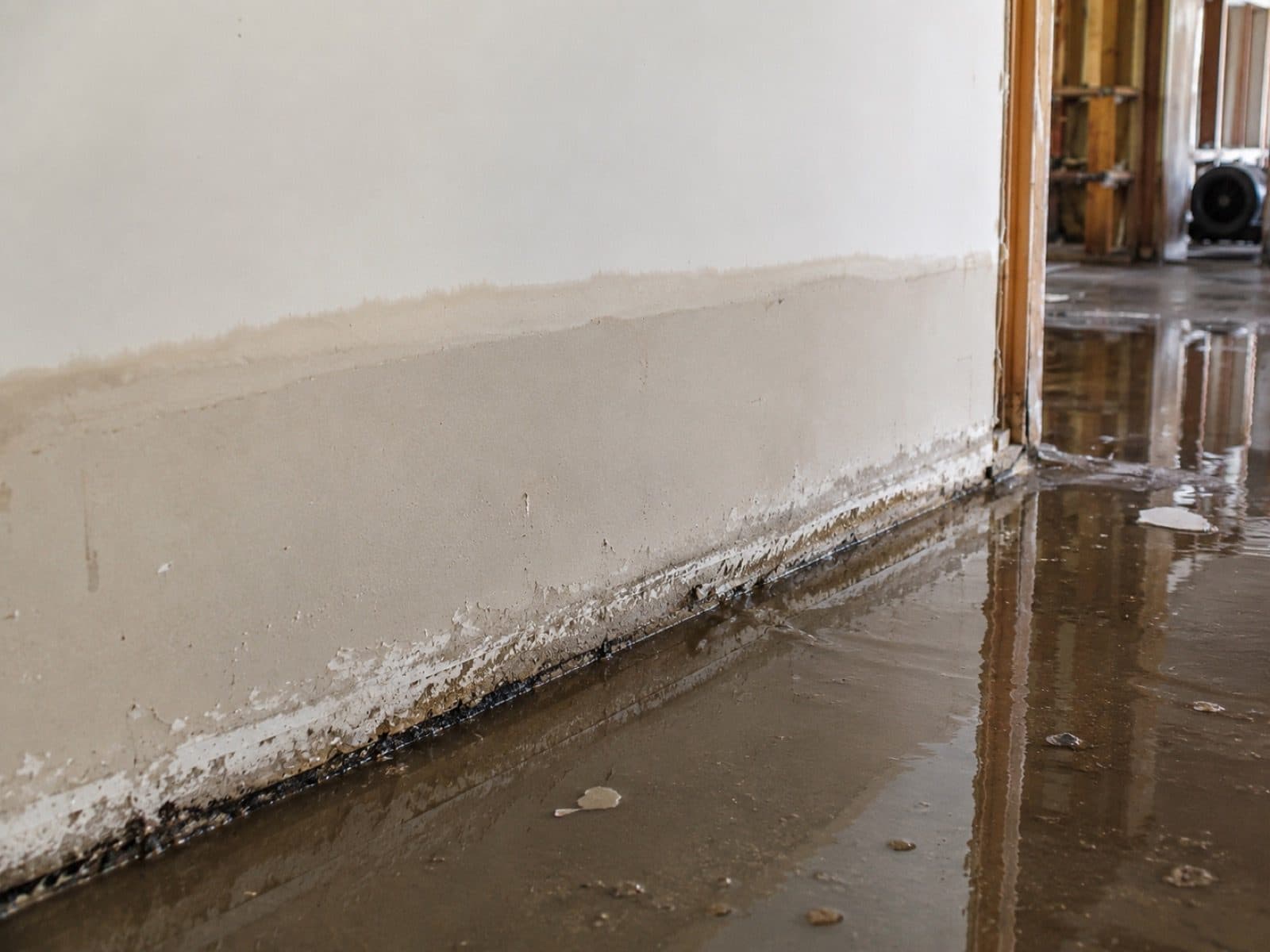
Southington Flood History
Southington experiences recurrent flooding throughout town, with flash flooding a standing concern along the Quinnipiac River floodplain and roads closing during the 100-year storm event, which the current regional hazard mitigation plan states is happening more frequently. FEMA maps the land immediately adjacent to the Quinnipiac and the Eightmile River as regulatory floodway where no new development is allowed. On September 2, 2021 the remnants of Hurricane Ida dropped roughly five inches of rain in hours and flooded downtown Plantsville, and the town has since been awarded a 300,000 dollar FEMA grant to assess that flood risk.
The USGS gage on the Quinnipiac at Southington reads a drainage area of just 17.4 square miles, which is why the river responds to a heavy rain in hours rather than days.
Source: 2024-2029 Capitol Region Natural Hazard Mitigation and Climate Adaptation Plan Update, Southington municipal annex; USGS gage 01195490, Quinnipiac River at Southington; Town of Southington Engineering Department via local reporting on the FEMA Plantsville grant. Photo: FEMA / DHS, public domain (representative regional photo).
- FEMA Designation
- Regulatory floodway, 1% and 0.2% annual chance zones
- Primary Flood Vectors
- Quinnipiac River flash flooding, downtown Plantsville street flooding, Tenmile confluence at Milldale, Misery Brook and ridge runoff, sewer backup, wind and fallen-tree damage
- NFIP Coverage Caps
- $250K building · $100K contents
- Response
- 60 min, 24/7
Verify Your Flood Zone
(860) 222-9498Complete Flood & Storm Damage Restoration In Southington, CT
One crew for both emergencies: storm stabilization, tarp-up and fallen-tree work, plus flood extraction for Quinnipiac flash flooding, downtown Plantsville street water, the Tenmile confluence at Milldale, brook and ridge runoff, and sewer backup. Every loss documented for your insurer.
IICRC S500 Category 3 Black Water Extraction
Water that has come out of the Quinnipiac or crossed a Southington street is Category 3 the moment it arrives, because it carries roadway runoff, storm-sewer content and soil bacteria whatever it looks like against a wall. Crews work in Tyvek and N95 with truck-mounted Hydramaster extraction and solids-rated submersible pumps, take porous material to the sill plate, apply EPA-registered antimicrobial per S520-2024, and dry against readings rather than against a schedule.
Full PPE, Tramex CME 5 verified
Quinnipiac River Flash Flooding
The town hazard plan names flash flooding along the Quinnipiac floodplain as a standing concern and notes that roads close during the 100-year storm event, which is happening more frequently. The USGS gage on the Quinnipiac at Southington reads a 17.4 square mile drainage, small enough that a heavy cell can move the river inside an hour. We stage on the forecast rather than after the crest, because that hour is the whole scope.
Staged on forecast, pumps on the call
Downtown Plantsville Response
On September 2, 2021 the remnants of Hurricane Ida dropped five inches of rain in hours and flooded downtown Plantsville, and the town has since won a 300,000 dollar FEMA grant to study the flood risk there and plan changes near the river. Much of the riverine infrastructure in that stretch is over a hundred years old. Plantsville losses get scoped as a downtown block problem, where a wet footprint crosses lease lines and one cellar serves several tenancies.
Block-level containment, tenancies stay open
Additional Restoration Services
Regulatory Floodway Property On The Quinnipiac And Eightmile
FEMA maps the land immediately beside the Quinnipiac and the Eightmile River as regulatory floodway, a stricter designation than floodplain where no new development is allowed. That changes what can be rebuilt after a loss and what an elevation requirement will look like on the permit. We flag floodway exposure in the file at the start rather than letting it surface during reconstruction.
Milldale And The Tenmile Confluence
The Tenmile River meets the Quinnipiac in the Milldale section, and the 1 percent annual chance flood zones associated with that junction cross multiple roadways. The Water Pollution Control Facility and South End School both sit inside that flood risk area, with further vulnerability near the school tied to Misery Brook. Two watercourses arriving together is a different event from one river rising, and the scope follows the confluence rather than a single bank.
The Named Road-Closure Streets
Southington keeps a working list of streets that flood: Curtiss Street, Mill Street, South Main Street, Woodruff Street, Old Turnpike Road and Darling Street, and the town diverts traffic off them when heavy rain is forecast. The plan notes roads usually do not stay closed more than a day and that the flooding is overtopping without roadbed damage, which is exactly why the loss lands in the buildings alongside the road instead of in the pavement.
Repetitive-Flood Property Documentation
Around eight to ten Southington properties flood on a periodic basis, and the town has considered seeking funds to buy out repetitive-loss structures. If yours is one of them, the file matters more than usual: a clean, dated, photographed record of each event is what supports both the next claim and any future acquisition or elevation grant. We build the packet with that second use in mind, not only the immediate one.
Brook And Ridge Runoff Into Lower Levels
Most of Southington drains to the Quinnipiac while the eastern edge drains toward the Mattabesset in Berlin, and between the two run Cussgutter Brook, Roaring Brook, Hamlin Brook, Humiston Brook and Misery Brook. With ground rising from about 110 feet to about 930 feet across town, runoff on the higher streets arrives fast and shallow rather than as a river event, and it finds slab penetrations and window wells first.
Emergency Roof Tarp-Up And Board-Up
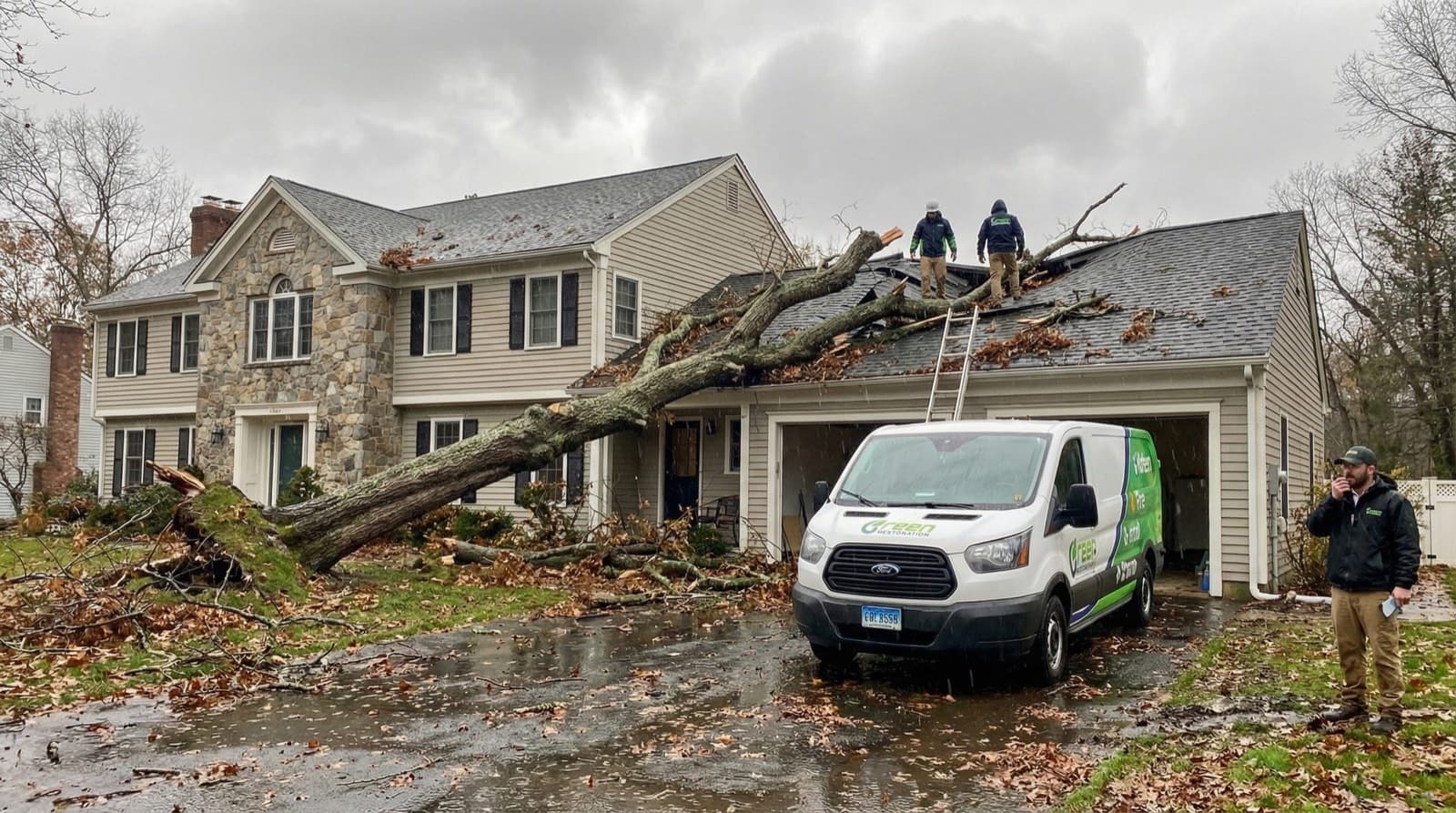
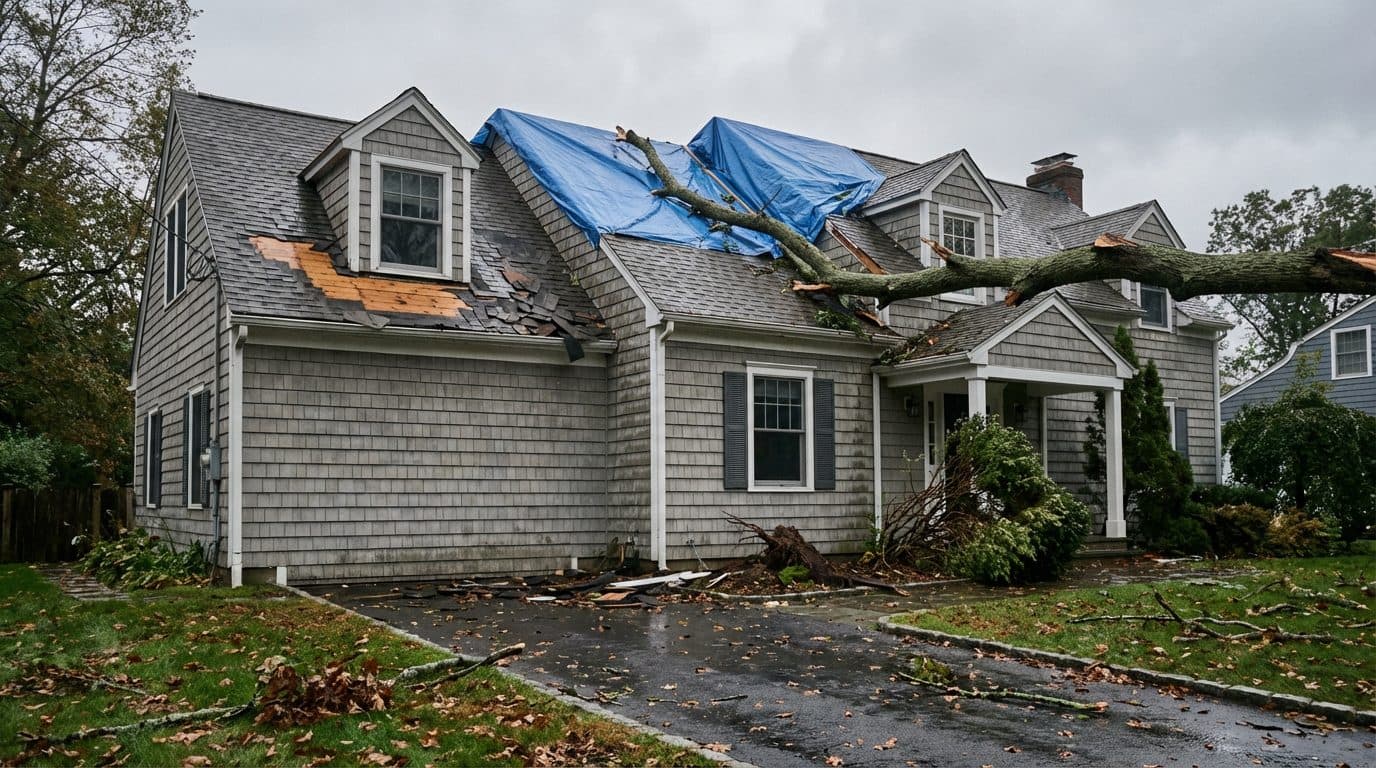
Storm stabilization happens on the same visit as the water work. Broken windows and doors boarded, wind-stripped or tree-struck roof sections tarped to a weather-tight seal with furring strips and roofing nails, standing water extracted before it reaches another assembly. Getting the envelope closed is what stops a one-room loss from becoming a whole-floor one overnight.
Fallen Tree And Wind Impact Response
Tropical Storm Isaias brought branches down and power outages across Southington, and the town notes that Eversource has done substantial tree trimming over the past decade working closely with Public Works. Trees that fall into the river itself are the harder problem, because clearing them means access across private property. Crews arrive with structural shoring and generator power and move straight into water mitigation wherever the canopy breached the envelope.
NFIP Documentation And The 60-Day Proof Of Loss
Rising surface water is excluded from a standard Connecticut homeowner policy and needs separate NFIP coverage, and Southington has participated in the program since 1981. A signed Proof of Loss is due to the flood carrier within 60 days of the date of loss and federal courts enforce that strictly. We submit scope, daily moisture logs, timestamped high-water photography and the written source finding directly to your insurer. We are not licensed public adjusters and do not negotiate claims on your behalf.
Structural Drying And Mold Prevention
Phoenix Axial movers and LGR dehumidifiers are set by psychrometric calculation and run until Tramex CME 5 readings meet the IICRC S500 dry standard at every mapped point, with grain depression and dew point logged daily. Nineteenth-century downtown block cellars and older Plantsville and Milldale foundations release water slowly and split when pushed, so those assemblies get their own monitoring points instead of a room average.
Do Not Let Flood Damage Set Into The Structure. Every Minute Counts.
Quinnipiac Floodway Response, Plantsville Block Cellar Drying And Category 3 Black Water Specialists For 06489 And 06479.
Why The Water Category Decides Everything In A Southington Flood
Per IICRC S500-2021 §5.3, every flood loss is classified Category 1, 2, or 3 before scope is signed. Category drives demolition extent, antimicrobial protocol, drying timeline, and what your insurance carrier expects to see in the documentation. Flooding in Southington is Category 3 from the first minute in most cases, whether it came out of the Quinnipiac floodway through Plantsville, down a closed street like Curtiss or Darling into a cellar, or back up a basement drain after a long rain.
Common Sources
Burst supply line, ice maker overflow, sink overflow
Restoration Protocol
Extract, dry, sanitize. Most porous materials salvageable if dried within 24 to 48 hours.
Drying typically 3 to 5 days
Common Sources
Washing machine discharge, dishwasher overflow, toilet overflow without solids, aquarium leak
Restoration Protocol
Extract, antimicrobial pre-treatment, dry, post-clean sanitize. Saturated carpet pad and porous insulation typically discarded.
Drying typically 4 to 7 days
Common Sources
Sewer backup, standing surface water, Quinnipiac and Eightmile River overflow, Tenmile confluence water at Milldale, street runoff into cellars, toilet overflow with solids
Restoration Protocol
Full PPE response, controlled demolition of porous materials to sill plate, EPA-registered antimicrobial per IICRC S520-2024, post-treatment clearance sampling.
Restoration typically 7 to 14 days including reconstruction
Why this matters for Southington, CT
Wind-driven rain that enters through a roof breach can stay Category 1 if treated within hours.
The same water becomes Category 2 after 48 hours in a warm cavity, and Category 3 once it contacts standing sewage, soil, or decomposing organic material.
Water that has been in the Quinnipiac or across a Southington street arrives already carrying roadway runoff, soil bacteria and storm-sewer content, which puts it at Category 3 under S500 section 5.3 regardless of how clear it looks against a wall. On a 17.4 square mile drainage the water also arrives fast, so the volume is in the building before anyone has decided what to call it. Getting that classification wrong on day one is exactly what turns a week of drying into a demolition scope a month later.
Our Flood & Storm Damage Restoration Process In Southington, CT
From the first call to final walkthrough, every step is documented, insured, and owner-supervised.
How would you like
to start?
Common range across Category 1 clean rainwater intrusion through Category 3 Quinnipiac water and sewer backup with porous demolition to the sill plate. A floodway parcel can carry an elevation requirement during reconstruction that sits outside the mitigation number. Final pricing follows the on-site Tramex inspection.
Get A Price Range In 60 Seconds.
Four quick IICRC S500-aligned questions. Starting figures published on this page. No call required, no email collected before you see the range.
Walk The Loss With The Owner.
Tramex CME 5 mapping plus a FLIR scan of the cellar and the framing above it, and a FEMA Map Service Center check on whether the parcel is floodway or floodplain. Free, no obligation, owner-led on every Southington flood job.
Ranges shown are starting figures only. Final pricing depends on on-site inspection, NFIP zone reference, and carrier coverage. We are not licensed public adjusters.
Why Choose Us In Southington
Owner-led service with 60-minute response, direct insurance billing, and eco-friendly methods across Southington.
60-Minute Emergency Response
IICRC-certified crews arrive within 60 minutes, day or night, every day of the year.
Owner-Operated Local Crew
Every job is personally overseen by our owner, from first call to final moisture reading.
Direct Insurance Billing
We bill State Farm, Liberty Mutual, USAA, Travelers, Allstate, and Chubb directly under HIC.0668405.
EPA-Registered Antimicrobials
EPA-registered antimicrobials and Safer Choice cleaning products applied per IICRC S500 and S520 standards.
Southington Emergency Utility Lines
Stopping water at the source is step 1 of any water-damage scope. Use these verified Southington lines while our IICRC crew is en route.For life-threatening emergencies (active fire, gas odor, electrical shock), call 911 first.
Water Authority
Southington Water Department
(860) 628-5593
Town-run water utility. Call to shut the street main or report a main break.
Source: southingtonct.gov
Gas Leak
Eversource Gas (Yankee Gas)
(877) 944-5325
If you smell gas, leave immediately, call 911 first, then this line from a safe location.
Source: eversource.com
Electric Emergency
Eversource Electric
(800) 286-2000
Submerged outlets or wet panel: cut breaker, then call to confirm service drop is safe.
Source: eversource.com
Police (Non-Emergency)
Southington Police
(860) 378-1600
Sewer-backup Cat-3 claims sometimes need a police report. Call dispatch.
Source: southingtonct.gov
Numbers verified against public utility and municipal sources. Green Restoration is not affiliated with these agencies. We provide these as a courtesy resource alongside our IICRC water-damage response.
FEMA Flood Zones In Southington, CT
Your FEMA zone decides whether your mortgage lender requires NFIP coverage, what premium tier you pay, and which Base Flood Elevation determines a covered loss. We document zone designation, BFE, and high-water mark on every Southington flood scope so adjusters from Wright National Flood, Allstate Flood, and Write-Your-Own carriers have what they need to approve the claim.
The channel plus the adjoining ground required to carry the base flood. A regulatory designation stricter than floodplain, where no new development is allowed.
Affected In Southington
Land immediately adjacent to the Quinnipiac River and the Eightmile River
NFIP required, rebuild restricted
1% annual chance floodplain carrying a published base flood elevation. NFIP coverage is required on federally backed loans.
Affected In Southington
Mapped Quinnipiac parcels and the 1% zones around the Tenmile confluence at Milldale, which cross multiple roadways
NFIP required
1% annual chance floodplain with no published base flood elevation, the usual case on smaller tributaries.
Affected In Southington
Unnumbered floodplain along Misery Brook, Roaring Brook, Hamlin Brook and other tributary reaches
NFIP required
0.2% annual chance flood hazard area or ground outside the mapped 1% zone. Roughly 25% of NFIP claims still originate in lower-risk zones.
Affected In Southington
The wider downtown Plantsville area and the higher residential streets rising toward the eastern and western ridgelines
NFIP optional
Zone definitions sourced from FEMA Flood Map Service Center + 44 CFR Part 64. Verify your property zone before any policy renewal.
Where Flood Zones Hit Hardest In Southington
Regulatory floodway where no new development is allowed, which changes what can be rebuilt after a loss
Flooded on September 2, 2021 under five inches of rain in hours; subject of a 300,000 dollar FEMA flood-risk study
1% annual chance zones cross multiple roadways; the Water Pollution Control Facility and South End School sit in the flood risk area
Named by the town as streets with flooding concerns; traffic is diverted from them when heavy rain is predicted
Sourced from FEMA Map Service Center FIRM panels for Southington, CT. Verify your property zone before policy renewal.
What To Do After Flooding In Southington, CT
River water out of the floodway, runoff down a closed street, and a drain running backward under a downtown block are three separate emergencies that arrive on the same bad night. On a drainage this small the water gets there fast. Here is what the first hour looks like, and what to leave alone.
What To Do Immediately
Downtown block cellars are dark, uneven and wired in layers nobody documented, and the panel usually sits in the lowest corner. Move everyone up and let Eversource clear the building before anyone goes back down for anything.
The adjuster values what the first frames show. Capture the highest line on every wall, the mechanicals and anything stored at floor level, timestamped, plus a frame of the drain if water came up through it.
Kill the main if you can reach a dry panel without standing in water. In an older Plantsville or Milldale building that is often not possible, and when there is any doubt the call goes to Eversource instead of into the water.
Anything out of the Quinnipiac, off a street, or up a drain is Category 3 under IICRC S500 section 5.3 on contact. N95, gloves and eye protection, or stay out of the space entirely.
The NFIP Proof of Loss is due to your flood carrier 60 days from that date and federal courts do not extend it. Southington has been in the program since 1981. We begin building the packet on day one so the deadline never becomes the reason a claim fails.
Hartford County crews arrive within 60 minutes in Southington with truck-mounted extraction, solids-rated pumps and PPE already loaded, and we route around whichever closure streets are under water.
What NOT To Do
A submerged outlet and a live panel turn standing water into an electrical hazard you cannot see through. Nothing stored in that cellar justifies entering before shutoff is confirmed.
A shop vac moves a few gallons and spreads contamination the whole time. River water and drain backup need solids-rated pumping and truck-mounted extraction, and every remaining surface still needs antimicrobial treatment afterward.
In an older building the boiler or furnace is the first thing underwater. Firing it back up drives whatever the water carried through the entire structure. It stays off until it has been inspected.
Once it leaves the building the adjuster cannot value it. We inventory and photograph business stock and household contents first, then separate what can be saved for pack-out and controlled drying.
Backed-up sanitary flow is a biohazard rather than a mess. Consumer cleaners do not address it and the exposure is respiratory as well as contact. Containment and EPA-registered antimicrobial come first, applied by crews in Tyvek.
Colonization starts inside 24 to 48 hours and older cellars hide it well. Your policy already obliges you to prevent further damage, so waiting on a callback grows the loss and weakens your position on coverage.
The Flood-Control System Behind Southington
Southington is a managed valley rather than a safe one. A small, fast river runs the length of the town under a stricter federal designation than most people realize, the town keeps a written list of the streets it closes, and the record of what has and has not worked is public. Each of those belongs in the file.
Quinnipiac And Eightmile Regulatory Floodway
FEMA Region 1 and the Town of Southington Engineering Department
FEMA maps the land immediately adjacent to the Quinnipiac River and the Eightmile River as regulatory floodway, where no new development is allowed, with the wider downtown Plantsville area falling in the 0.2 percent annual chance flood hazard zone. Floodway status is stricter than floodplain and it constrains reconstruction after a loss, so we pull the designation for the parcel before scope rather than after.
The 300,000 Dollar FEMA Plantsville Study
Federal Emergency Management Agency and the Town of Southington
After the remnants of Hurricane Ida dropped roughly five inches of rain in hours on September 2, 2021 and flooded downtown Plantsville, the town was awarded a 300,000 dollar FEMA grant to assess flood risk there and plan modifications near the Quinnipiac. The town engineering department has noted that limited existing information is available through FEMA for the area, and that much of the riverine infrastructure in that stretch is more than a hundred years old.
Local Flood Storage And The Route 10 Dam Removal
Town of Southington
The town owns an open space parcel at 1 Hightower Road equal to 13,610 cubic yards of flood storage and sells that storage to developers who need to mitigate. A low-hazard, two-foot run-of-the-river dam on the Quinnipiac near the bowling alley on Route 10 has been removed, which town staff connect to Plantsville not having flooded recently. Separately, a floodplain excavation on Farmstead Street intended to add storage does not appear to have resolved the issue there. Both outcomes are in the public record and both are relevant to what a homeowner should expect.
Southington NFIP Participation And Elevation Rules
Federal Emergency Management Agency and Town of Southington Zoning
Southington has participated in the National Flood Insurance Program since 1981 and updated its Flood Damage Prevention Regulations in 2017. The 2023 zoning regulations require buildings in a special flood hazard area to be elevated two feet above base flood elevation for residential and one foot for non-residential construction, and mandate zero increase in runoff in floodplain areas. That elevation requirement is what an Increased Cost of Compliance discussion turns on during reconstruction.
Flood Damage Restoration Coverage In Southington, CT
Quinnipiac floodway overflow, downtown Plantsville street flooding, Tenmile confluence water at Milldale, brook and ridge runoff and Category 3 sewer backup cleanup for Southington homes and downtown commercial property. Hartford County inland flood specialists with a 60-minute response across all 16 areas we cover in town.
Green Restoration provides IICRC S500-certified flood damage restoration in Southington, CT, with deep coverage across neighborhoods most exposed to Quinnipiac River flash flooding through the regulatory floodway, downtown Plantsville street flooding, the Tenmile confluence at Milldale, Misery Brook and ridge runoff, and sewer backup.
Land immediately beside the Quinnipiac and the Eightmile River sits in regulatory floodway rather than ordinary floodplain; downtown Plantsville took five inches of rain in hours on September 2, 2021 and is now the subject of a federal flood-risk study; the Milldale section around the Tenmile confluence carries 1 percent annual chance zones that cross multiple roadways; and the town names Curtiss Street, Mill Street, South Main Street, Woodruff Street, Old Turnpike Road and Darling Street as its streets with flooding concerns.
With direct access via Interstate 84 and Interstate 691 through town, plus Routes 10, 120, 177, 229, 322 and 364 from our Hartford County location, our IICRC-certified crews respond in 60 minutes, day or night.
As a locally owned company based at Hartford-Tolland Mobile Dispatch, serving Southington and central Hartford County, CT, we know the specific challenges Southington properties face: nineteenth-century downtown block cellars in Plantsville where one wet footprint crosses several tenancies, older Milldale and Marion foundations that hold water in the masonry long after the finished face reads dry, and post-war slab stock on the higher streets where ridge runoff finds penetrations and window wells first, and the IICRC S500 §5.3 Category 3 protocol every flood requires on arrival.
We submit IICRC-standard documentation directly to your insurer. We are not licensed public adjusters and do not negotiate claims on your behalf.
Flood Emergency In Southington?
Category 3 dispatch and NFIP documentation, 24/7/365.
(860) 222-9498IICRC Certified Firm · Licensed & Insured · CT HIC.0668405 · All Insurance Accepted
See typical Southington flood damage pricing in 60 seconds. Category 1 to 3.
All Towns Served By Green Restoration Of Hartford County From Our Hartford County Location For Emergency Flood Damage Restoration & NFIP Documentation.
Free On-Site Assessment
Not sure what you are dealing with in Southington?
We establish the scope on site, before anything is quoted.
(860) 222-9498How The Quinnipiac Shapes A Southington Flood Scope
Southington covers 35.9 square miles between two ridgelines, with ground running from about 110 feet on the valley floor to about 930 feet at the high points. The majority of town drains to the Quinnipiac River while the eastern edge drains toward the Mattabesset in Berlin, and between them run Cussgutter Brook, the Eightmile River, Roaring Brook, Hamlin Brook and Misery Brook. The important number is small: the USGS gage on the Quinnipiac at Southington, station 01195490, reads a drainage area of just 17.4 square miles, which is why the river answers a heavy rain in hours rather than days.
The town describes recurrent flooding throughout town with localized flooding at known locations, calls flash flooding along the Quinnipiac floodplain a standing concern, and reports that roads close during the 100-year storm event, which is happening more frequently. It names the streets: Curtiss, Mill, South Main, Woodruff, Old Turnpike, Darling, plus the Plantsville neighborhood. Those roads usually reopen inside a day and the flooding is overtopping without damage to the roadbeds, which is precisely why the cost lands in the buildings beside them. FEMA maps the ground immediately next to the Quinnipiac and the Eightmile as regulatory floodway where no new development is allowed.
Downtown Plantsville took roughly five inches of rain in hours on September 2, 2021 from the remnants of Hurricane Ida, and the town has since won a 300,000 dollar FEMA grant to study that risk, with engineering staff noting that much of the riverine infrastructure there is over a hundred years old. Around eight to ten properties in town flood on a periodic basis, and the town has considered seeking funds to buy them out.
24/7 Flood & Storm Damage Response In Southington, CT
Our IICRC-certified Hartford County flood crew answers Southington Category 3 emergencies around the clock. The response into 06489 and 06479 is 60 minutes with full PPE, Hydramaster extraction and solids-rated pumps already on board, and during an active event we route around whichever closure streets are under water rather than waiting them out.
Calls answered around the clock by our team or AI assistant and transferred to a human on flood emergencies. Trucks leave the Hartford County base with full PPE arriving within 60 minutes in Southington, and stage on the forecast when the Quinnipiac is loading rather than after the crest.
Every flood job follows IICRC S500-2021 section 5.3 and S520-2024: full PPE extraction, controlled porous demolition to the sill plate, EPA-registered antimicrobial, structural drying with daily Tramex CME 5 verification, and independent laboratory clearance before reconstruction.
Land immediately beside the Quinnipiac and the Eightmile is regulatory floodway, not ordinary floodplain, and that constrains what can be rebuilt. We pull the FEMA Map Service Center designation for the parcel at the start so the constraint surfaces in the estimate rather than at the permit counter.
Federal courts enforce the 60-day NFIP Proof of Loss deadline strictly, and Southington has been in the program since 1981. Every Southington flood project is documented with timestamped photo logs, daily moisture readings, FEMA zone and floodway reference and a complete scope packet ready to file well inside the window.
About Green Restoration In Southington, CT
Your Southington Flood & Storm Damage Specialists Since 2014
Green Restoration provides IICRC S500 flood damage cleanup and structural drying for homes, downtown commercial blocks and light industrial property throughout Southington, CT. The protocol centers on Category 3 black water extraction, controlled porous demolition across nineteenth-century block cellars and post-war slab stock alike, EPA-registered antimicrobial per S520-2024, floodway and floodplain designation pulled for the parcel at the start, and NFIP-formatted documentation opened on the first call. We work with property owners, NFIP Write-Your-Own carriers and Connecticut homeowners insurers to scope the loss plainly, log moisture daily, and bring every affected assembly to the ANSI and IICRC dry standard before reconstruction is discussed. We are not licensed public adjusters and do not negotiate claims on your behalf.

“As the local co-owner across Hartford County, I bring 15 years in restoration and IICRC AMRT plus WRT certifications to every Southington flood scope. A Plantsville block can take water off the street and out of the river on the same night and the cellar underneath it serves more than one business, which makes it a containment problem before it is a drying problem. A house on Curtiss or Darling is a different file again, because the town already knows that street floods and so does the adjuster. Every Southington job gets my direct oversight, documented to S500 standard, billed to your carrier.”
How Much Does Flood Damage Restoration Cost In Southington, CT?
Cost tracks the IICRC S500 Category, the affected square footage and the reconstruction behind it. Most Quinnipiac and sewer backup claims in Southington land in the Category 3 band from $8,000 to $50,000 plus, driven by porous demolition to the sill plate and laboratory-verified clearance.
River + Sewer Backup
$8,000 to $50,000+
Quinnipiac floodway water and downtown drain backup, silt removal, porous demolition to the sill plate, laboratory-verified clearance
Surface Flooding
$3,500 to $12,000
Ridge runoff and storm ponding into a finished lower level with light silt loading
Clean Rainwater
$1,500 to $4,500
Rain through an opening the wind created, handled within hours of the storm
Final cost depends on the water Category, affected square footage, drying duration, porous demolition scope to the sill plate, how many tenancies a shared cellar reaches, and any elevation requirement on a floodway or floodplain parcel during reconstruction. Use the calculator above for a personalized Southington estimate.
Southington Flood Damage Restoration FAQs
Straight answers on the Quinnipiac regulatory floodway, NFIP coverage, what happened in Plantsville in September 2021, which streets the town closes, Category 3 protocol, the dams upstream, cost and timeline.
Parts of it are, and one part carries a stricter designation than most homeowners expect. FEMA maps the land immediately adjacent to the Quinnipiac River and the Eightmile River as regulatory floodway, which is the channel plus the ground needed to carry the flood, and no new development is allowed there at all. Beyond it sits the mapped 1 percent annual chance floodplain, and the wider downtown Plantsville area falls in the 0.2 percent annual chance flood hazard zone.
The 1 percent zones associated with the Quinnipiac and Tenmile River junction at Milldale cross multiple roadways, and both the Water Pollution Control Facility and South End School sit inside that area. Verify your own parcel at the FEMA Map Service Center before a purchase or a policy renewal, because floodway status changes what you are allowed to rebuild.
No. Connecticut HO-3 and HO-5 policies exclude flood, surface water and river overflow as a class. Quinnipiac River overflow through Plantsville, Eightmile River high water, Tenmile confluence flooding at Milldale and street runoff into a cellar all fall to a separate NFIP flood policy written through a Write-Your-Own carrier. Southington has participated in the NFIP since 1981. What the homeowners policy generally does cover is a sudden supply-line burst, an appliance overflow, and wind-driven rain through an opening the wind created. Sewer and drain backup is excluded unless you carry a backup endorsement. Green Restoration documents both paths and submits an IICRC S500 scope to each carrier separately. We are not licensed public adjusters and do not negotiate claims on your behalf.
The remnants of Hurricane Ida dropped roughly five inches of rain on Southington in a matter of hours and flooded downtown Plantsville, an event documented at the time by drone photography. It is the clearest recent illustration of what a small drainage does under a stalled cell: the USGS gage on the Quinnipiac at Southington reads only 17.4 square miles of drainage area, so the river responds to a heavy rain in hours rather than days.
The town has since been awarded a 300,000 dollar FEMA grant to assess the flood risk in downtown Plantsville and plan modifications near the Quinnipiac, with the town engineering department noting that limited existing information is available through FEMA for that area.
The town names them. The current regional hazard mitigation plan lists Curtiss Street, Mill Street, South Main Street, Woodruff Street, Old Turnpike Road, Darling Street and the Plantsville neighborhood as the specific streets with flooding concerns, and notes that Southington diverts traffic away from at-risk roads when heavy rain is predicted. Town staff report that the Plantsville area has not flooded recently, which may be connected to the removal of a low-hazard, two-foot run-of-the-river dam on the Quinnipiac near the bowling alley on Route 10.
The plan also records that roads usually do not stay closed for more than a day and that the flooding is overtopping without erosion or damage to the roadbeds, which is precisely why the losses land in the buildings alongside those streets rather than in the pavement.
IICRC S500-2021 section 5.3 classifies water by contamination rather than by appearance. Category 1 is clean supply-line water from a burst pipe or an appliance hookup, and most porous material survives if it is dried inside 24 to 48 hours. Category 2 is gray water from a washing machine, dishwasher or toilet bowl without solids, needing antimicrobial pre-treatment and removal of saturated pad and porous insulation. Category 3 is black water: sewer backup, standing surface water, and Quinnipiac, Eightmile or Tenmile River overflow. Category 3 means full PPE, controlled demolition of porous material to the sill plate, EPA-registered antimicrobial per IICRC S520-2024, and post-treatment verification.
River water and street runoff are Category 3 on arrival because they carry roadway runoff, soil bacteria and storm-sewer pollutants regardless of how clear they look.
Our response across Southington is 60 minutes, 24 hours a day, covering Plantsville, Milldale, Marion, Southington Center and the Queen Street corridor. Crews dispatch with truck-mounted Hydramaster CDS-4.8 extractors, submersible pumps rated for solids, Phoenix Axial movers, LGR dehumidifiers, Tyvek and N95 PPE and EPA-registered antimicrobials staged on every truck. Interstates 84 and 691 both run through town, which helps on most calls, but during an active event the named closure streets change the route rather than the response. Call (860) 222-9498 at any hour.
NFIP requires a signed Proof of Loss with your Write-Your-Own carrier within 60 days of the date of loss, and federal courts enforce that window strictly. One day late is denial grounds. Green Restoration provides timestamped photo logs, daily IICRC S500 moisture readings, high-water-mark photography, FEMA Map Service Center zone reference for the parcel, and a complete itemized scope formatted for direct adjuster submission, so a Southington homeowner meets the deadline with a defensible file covering Quinnipiac floodway, Plantsville downtown and Milldale confluence losses alike.
Cost tracks the water Category, the affected square footage, how long drying runs and how much reconstruction follows. Surface water off a ridge street or storm ponding into a finished lower level generally runs 3,500 to 12,000 dollars for extraction, antimicrobial treatment and structural drying. Category 3 river water or sewer backup into a downtown Plantsville block cellar or an older Milldale foundation runs 8,000 to 50,000 dollars and up, driven by porous demolition to the sill plate, full PPE crew hours, laboratory-verified clearance and the slow drying curve of nineteenth-century masonry. A floodway parcel can also carry an elevation requirement during reconstruction, which sits outside the mitigation number entirely.
Yes, and the distinction matters for the claim. Connecticut homeowner policies generally do cover wind, hail and fallen-tree damage to the structure, including interior water intrusion through a wind-created opening, subject to your deductible. What they exclude is rising surface water and sewer backup. Tropical Storm Isaias brought branches down and power outages across Southington, and the town notes that Eversource has done substantial tree trimming over the past decade working closely with Public Works. After a storm a single loss often has both causes at once, so we document each separately and send the right scope to the right carrier. We are not licensed public adjusters and do not negotiate claims on your behalf.
The record is public and worth reading plainly. More than 20 dams could affect Southington if they failed, and five Class C high-hazard dams lie inside the town boundary. Southington itself owns six dams including one Class C and one Class B, all reported in good condition.
The Class C list includes the New Britain Wolcott Reservoir Dam and Dike owned by the City of New Britain above Roaring Brook, the Plainville Reservoir Dam owned by the Southington Water Department above a tributary to Patton Brook, Southington Reservoir No. 3 on Humiston Brook, the Wasel Reservoir Dike above the Mattabassett River, and the privately owned Spring Lake Dam on the Quinnipiac. None of these dams generate power; they are water-supply and recreation structures.
The plan notes that Spring Lake Dam has a maintenance issue identified by state environmental staff, that the owner and the state are reportedly working to address it, and that a 100-home subdivision sits close downstream in the likely inundation area near Woodruff Road and Marcy Drive.

