If your house was built before 1980, the honest answer is: probably, somewhere. That sounds alarming. It should not be. Asbestos went into dozens of ordinary building products for most of the twentieth century, and a great deal of it is still sitting in New England homes right now, doing nothing at all.
What matters is not whether asbestos is present. It is whether it is disturbed. Asbestos is dangerous when fibres get into air you breathe. Material that is intact, sealed and left alone generally is not releasing anything.
So the useful version of your question is narrower. What do I have, where is it, is it damaged, and am I about to disturb it? Here is how to work through that.
Where It Actually Is
These are the materials we find most often in Connecticut, Massachusetts and New York houses. Age is the first clue in every case.
Pipe And Boiler Insulation
This is the big one. Older basements often have heating pipes wrapped in a thick white or grey jacket. It may be corrugated, like cardboard. It may be plaster-like and painted over. Boilers and furnaces sometimes carry a similar jacket.
This is the most common asbestos hazard in an older home, and the one to treat most carefully. Old lagging gets brittle. A bump with a ladder can crumble it. If yours is torn, flaking, or shedding dust onto the floor, stay out of that area and get advice before you touch anything.
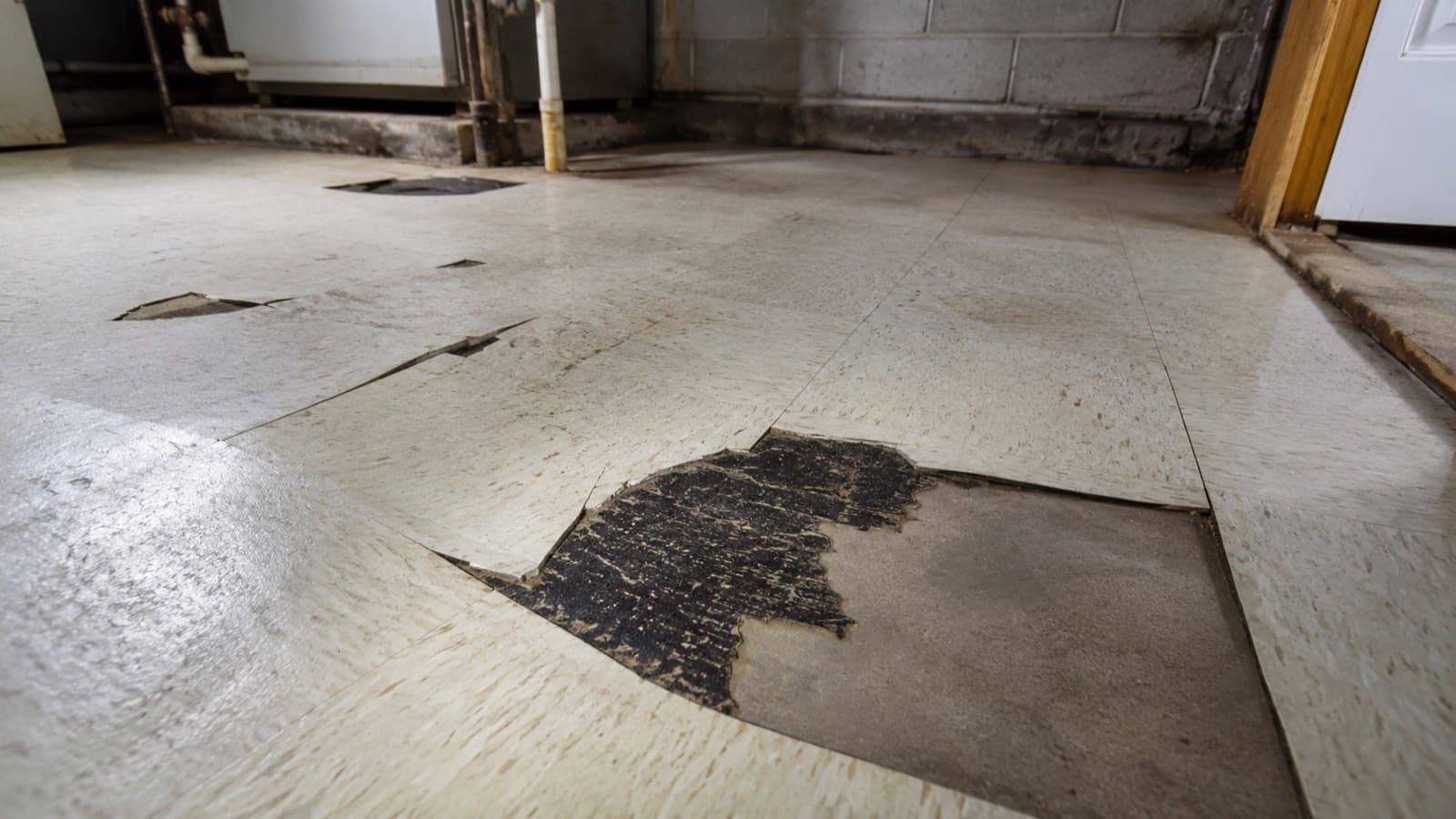
Floor Tile And The Black Glue Under It
Nine-inch by nine-inch floor tiles are a strong signal. So is the black tar-like adhesive underneath, called mastic. Both commonly contain asbestos in homes of that era. Twelve-inch tiles can too, though less often.
Here is the part people get wrong. Sanding, grinding or dry-scraping that floor is exactly what turns a harmless floor into an airborne problem. Plenty of renovations create the hazard that was not there the day before. Intact tile under a new floor is usually fine.
Textured And Popcorn Ceilings
Sprayed textured ceilings from the 1950s through the late 1970s often contain asbestos. So does some older patching compound and joint tape. Painted-over texture tends to be more stable than bare texture, because the paint holds the surface together.
Scraping a popcorn ceiling is a popular weekend project. It is also one of the worst things you can do to an unknown ceiling in a house of that age.
Vermiculite Attic Insulation
Loose grey-brown pebbles in the attic, roughly pea-sized, sometimes with a slight shine. That is vermiculite. Much of the vermiculite sold in the United States came from a single mine that was contaminated with asbestos, so it is treated as suspect.
If you have it, the guidance is unusually simple. Do not disturb it. Do not use that attic for storage. Do not let anyone run wiring or ductwork through it without knowing what it is. Sealing the gaps in the attic floor below it does more good than any project you can do up there.
Siding, Ducts And A Few Others
Cement asbestos siding shingles show up on plenty of 1940s and 1950s exteriors. They are hard, brittle, and usually stable unless someone power-washes or saws them. Transite ductwork, a grey cement-like round duct, appears in mid-century homes. Older window glazing, roofing felt and some wall panels can contain it too.
The pattern is the same across all of them. Hard and intact is low risk. Crumbling, sawn, sanded or drilled is not.
You Cannot Tell By Looking
Nobody can identify asbestos by eye. Not us, not a contractor, not a home inspector.
Why Identification Needs A Laboratory
Asbestos identification requires a lab looking at a sample under a microscope. Anyone who tells you a material definitely does or does not contain asbestos from a photograph is guessing.
That has a practical consequence. In a house of the right age, the safe default is to treat suspect material as if it contains asbestos until a lab says otherwise. That one habit prevents most accidental exposures.
And Sampling Is Itself A Disturbance
Taking a sample means breaking the surface of the very material you are worried about. Done casually, it releases the fibres you were trying to avoid.
In Connecticut, Massachusetts and New York, asbestos inspection and sampling are licensed activities with their own procedures. This is not a job for a homeowner with a utility knife and a sandwich bag.
The Answer Is Often: Leave It Alone
This is the part the internet handles worst, and the part that saves people the most money.
Removal Is Not Automatically Safer
Federal guidance is consistent here. Asbestos-containing material in good condition that will not be disturbed is generally best left in place.
Removal is a disturbance by definition. That is precisely why it is regulated so heavily. Tearing out intact material because its presence makes you uneasy can create an exposure that was never going to happen otherwise.
Three Outcomes, Not One
Leave it. Intact pipe wrap in a basement corner you rarely enter, tile under a floor, siding nobody is cutting. Photograph it, check it occasionally, and do not sand, drill or scrape it.
Manage it. Encapsulation seals the surface; enclosure covers it. Either can stop material shedding fibres for a fraction of removal cost. This is a legitimate answer, not a shortcut.
Remove it. Justified when material is damaged, when it sits somewhere it keeps getting knocked, or when your renovation is going to destroy it anyway. Then it comes out properly, before demolition starts.
What Removal Costs
Real numbers from our published pricing, for Connecticut, Massachusetts and New York work.
The Ranges
Asbestos abatement generally runs $5 to $20 per square foot. That band is wide because area alone is not the driver. Material type, containment and access matter more.
A small job, meaning under about fifty square feet of a single material, typically lands between $1,200 and $3,000. A typical interior project runs $1,500 to $5,000. A large job, meaning a whole room or floor, or several materials at once, runs $5,000 to $20,000.
Why Small Jobs Are Not Cheap
There is a floor under these numbers that surprises people. Even a tiny job needs containment, negative air, licensed labour, air clearance and regulated disposal.
That setup costs roughly the same whether the crew removes twenty square feet or sixty. It is why a very small abatement rarely comes in under about a thousand dollars, and why bundling several small items into one mobilisation is usually the cheaper way to do it.
What Moves The Price
Friable material, meaning anything that crumbles under hand pressure, costs more than hard material. Pipe lagging and vermiculite are friable. Floor tile and cement siding are not.
Access is the other big one. A tight crawl space, or a finished room that has to be sealed off and put back afterwards, costs more than an open basement.
Budget separately for reinstatement. Abatement removes material. It does not re-insulate your pipes or lay your new floor.
Who Is Allowed To Do The Work
The most important practical section on this page. Read it before you call anyone, including us.
It Is Licensed Work In All Three States
Connecticut licenses asbestos abatement contractors, inspectors and project designers through the Department of Public Health. Massachusetts licenses through the Department of Labor Standards. New York licenses through the Department of Labor.
Larger projects also carry notification requirements before work starts. A contractor who is vague about which licence they hold, or who offers to skip notification, is telling you something important.
What We Do, And What We Do Not
Green Restoration is not a licensed asbestos abatement contractor and we do not perform asbestos removal. We state that plainly because the industry is full of pages that blur it.
What we do is coordinate the project: the licensed inspector, the project designer where one is required, the licensed abatement contractor, and the independent air clearance at the end, under one file. That way a homeowner is not managing four vendors who have never spoken to each other.
Three Questions To Ask Any Abatement Contractor
Ask for the state licence number, then check it with the state yourself rather than taking the number on trust.
Ask who performs the final air clearance, and make sure it is not the same company doing the removal. The party certifying the work is clean should not be the party paid to finish it.
Ask for the waste disposal manifest. Asbestos waste is tracked to a licensed facility. A legitimate contractor expects all three questions and answers them without friction.
When You Do Not Need Anyone
Four situations where the right move is to spend nothing at all.
The Four Cases
Your house is post-1990 and nothing was renovated with salvaged material. Asbestos use in home construction had largely ended. You are almost certainly fine.
The material is intact and you are not touching it. Pipe wrap in good condition in a basement corner is not an emergency. Photograph it, leave it, look at it once a year.
You are covering, not removing. New flooring over intact old tile, or drywall over a textured ceiling, avoids the disturbance entirely. Confirm the approach first, but this is often the cheap right answer.
You only need to know before you buy. In a pre-purchase inspection you need information, not a project. Find out what is there and what condition it is in, then decide.
The One Case Not To Sit On
Damaged friable material in a space people use. Crumbling pipe insulation in a finished basement, or vermiculite that has been disturbed by a wiring job, belongs in a different category from everything above.
That one is worth a call the same day. Not because the house is unsafe to stand in, but because every week of continued use is more disturbance of material that is already shedding.
The Short Version
If you read nothing else on this page.
Three Sentences
Age tells you whether asbestos is likely. Condition tells you whether it matters. Your renovation plans tell you whether you have to act.
Intact and undisturbed is usually best left alone. Damaged, or in the path of demolition, needs licensed removal, which runs $1,200 to $3,000 for a small job and $5,000 to $20,000 for a large one.
And nobody, including us, can identify it by eye. In a house of the right age, treat suspect material as asbestos until a laboratory says otherwise.