Two appliances cause more of the kitchen and laundry room water calls we take across Connecticut, Westchester and Western Massachusetts than everything else combined: the washing machine and the refrigerator. One has two supply hoses under full house pressure all day whether it is running or not. The other has a thin plastic ice maker line pushed into an alcove nobody looks behind for years. When either one fails, the first question after "where is the shutoff" is "will insurance pay for this." It is a fair question: the Insurance Information Institute puts the average water damage and freezing claim at 15,400 dollars for 2019 to 2023, about one insured home in 60 files one each year, and in Massachusetts nearly half of all homeowners claims in 2024 were non flood water or freezing losses.
This guide answers both. It walks through the first ten minutes, where the water is actually coming from, what a standard policy covers and excludes, the add-ons that close the gaps, what the public claims data says about carriers, and how to file without making the claim worse. We are not insurance agents and we do not sell policies. We dry and rebuild houses, and we submit our documentation to whichever carrier you have.
Stop The Water First
Nothing in this article matters until the water is off. These steps are the same for a washer and a refrigerator, in this order.
The first ten minutes. The order matters: water, then power, then photographs, then calls.
1
- Action
- Close the supply valves
- Where
- Washer: the two valves on the wall behind the machine, hot and cold. Refrigerator: the small valve under the kitchen sink, in the basement below the kitchen, or at the main shutoff if you cannot find it.
- Why
- A supply hose runs at house pressure around the clock. Until the valve is closed, nothing else you do slows it down.
2
- Action
- Cut the power to that area
- Where
- The breaker, not the appliance switch, if water has reached an outlet, the machine itself or the floor under it.
- Why
- Washers and refrigerators sit on wet floors next to outlets. Do not stand in water to unplug anything.
3
- Action
- Pull the appliance out
- Where
- Only if it rolls easily and the floor is sound. Otherwise leave it.
- Why
- The worst of the water is behind and under the unit. You cannot dry what you cannot see.
4
- Action
- Move what is in the water
- Where
- Rugs, boxes, laundry, anything in a lower cabinet.
- Why
- In most appliance leaks the contents are what you actually lose. Wet cardboard and rugs also feed mold.
5
- Action
- Photograph everything before cleanup
- Where
- The failed hose or fitting, the puddle, the floor, the baseboard, the wall, the contents.
- Why
- The adjuster will ask what it looked like. A photo with the water still visible answers that.
6
- Action
- Call the insurer and a restoration crew the same day
- Where
- Claim number first, then drying.
- Why
- Policies expect prompt mitigation. Waiting for the adjuster to visit before drying starts is the most common mistake we see.
| Order | Action | Where | Why |
|---|---|---|---|
| 1 | Close the supply valves | Washer: the two valves on the wall behind the machine, hot and cold. Refrigerator: the small valve under the kitchen sink, in the basement below the kitchen, or at the main shutoff if you cannot find it. | A supply hose runs at house pressure around the clock. Until the valve is closed, nothing else you do slows it down. |
| 2 | Cut the power to that area | The breaker, not the appliance switch, if water has reached an outlet, the machine itself or the floor under it. | Washers and refrigerators sit on wet floors next to outlets. Do not stand in water to unplug anything. |
| 3 | Pull the appliance out | Only if it rolls easily and the floor is sound. Otherwise leave it. | The worst of the water is behind and under the unit. You cannot dry what you cannot see. |
| 4 | Move what is in the water | Rugs, boxes, laundry, anything in a lower cabinet. | In most appliance leaks the contents are what you actually lose. Wet cardboard and rugs also feed mold. |
| 5 | Photograph everything before cleanup | The failed hose or fitting, the puddle, the floor, the baseboard, the wall, the contents. | The adjuster will ask what it looked like. A photo with the water still visible answers that. |
| 6 | Call the insurer and a restoration crew the same day | Claim number first, then drying. | Policies expect prompt mitigation. Waiting for the adjuster to visit before drying starts is the most common mistake we see. |
Washing Machine Leaking From The Bottom
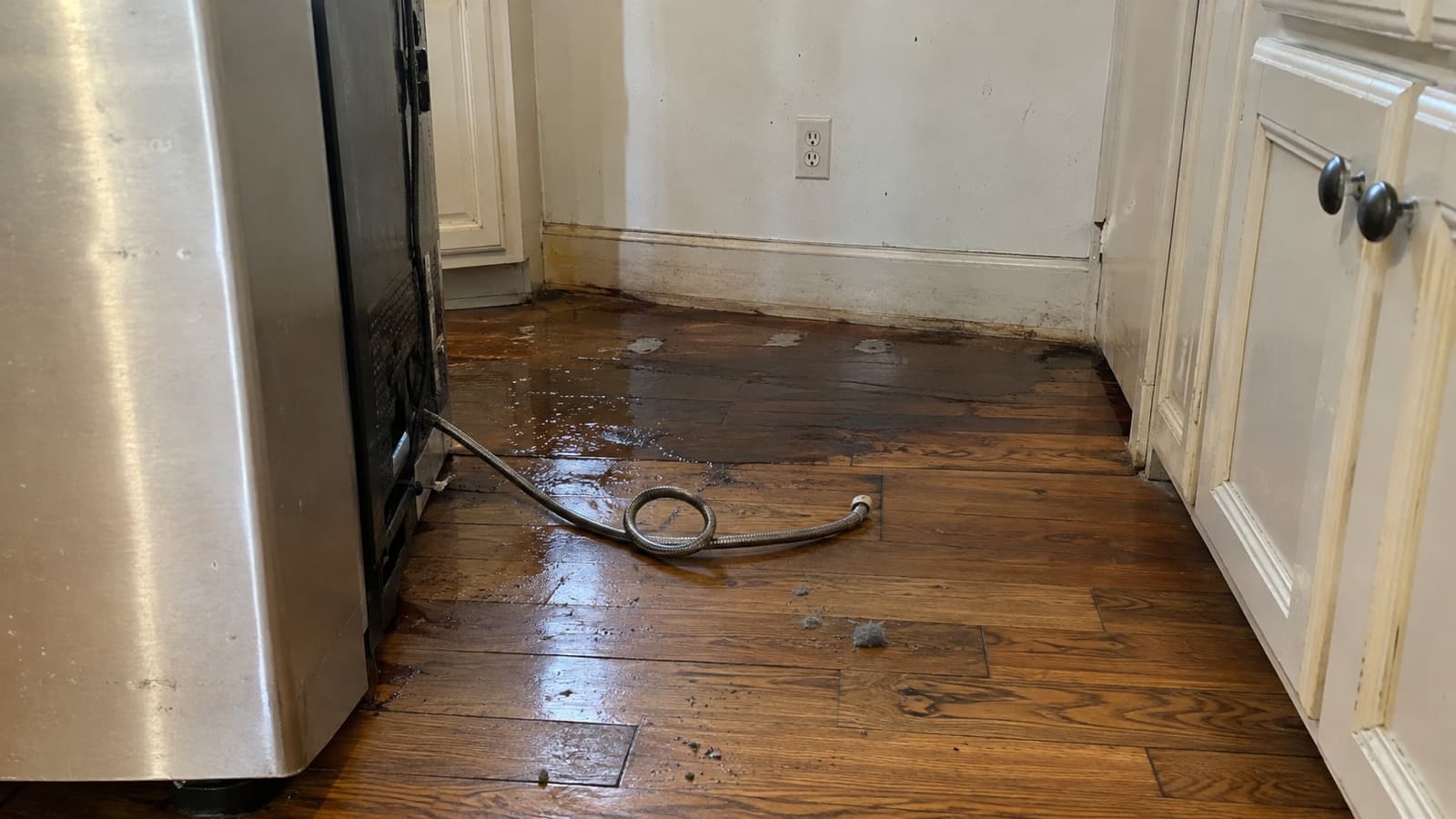
Where the water shows up tells you which part failed. Water under the machine only while it runs is usually the drain hose, the pump, or the tub seal, and it stops when the cycle does. Water under the machine while it is off is a supply hose or a fitting at the wall, and that is the dangerous one, because it is fed by house pressure and does not stop until someone closes the valve. A burst supply line is behind about half of all washing machine water losses, according to the industry study the Connecticut Insurance Department reprints for homeowners, and State Farm puts the flow from an open hose at typical house pressure near 650 gallons an hour. Front loaders add one more: the rubber door gasket, which leaks at the front when it tears or holds a sock in the fold. Pull the machine out, dry the floor, and run a short cycle while watching the back. Where the water returns first is the answer.
Refrigerator Leaking Water
A puddle at the front of a refrigerator is usually the defrost drain. It clogs, meltwater from the freezer backs up and runs out under the door, and no plumbing is involved. A puddle at the back, or a floor that is slowly cupping along the edge of the alcove, is the ice maker and water dispenser supply. That line is often quarter inch plastic tubing with a compression fitting, pushed into place when the refrigerator was delivered and never looked at again. The same industry study found that 73 percent of ice maker water losses were a failed supply line, and one in ten involved a newly installed refrigerator, usually a line pinched under a wheel or a fitting left loose on delivery day. It splits, or the fitting weeps, and because the refrigerator hides it, the leak can run for months before the floor shows it. That difference, a line that let go overnight versus a fitting that dripped since last winter, is exactly the line insurance draws, and the next section explains why.
"The washer hose is loud and sudden. The refrigerator line is quiet and slow. One is usually a claim. The other is usually an argument."
What A Standard Policy Covers
Standard homeowners forms sold in Connecticut, New York and Massachusetts treat appliance water the same way. Three ideas decide almost every claim.
Sudden And Accidental Discharge Is Covered
The standard homeowners form covers accidental discharge or overflow of water from a plumbing system or a household appliance. A supply hose that bursts, a drain hose that pops out of the standpipe mid cycle, an ice maker line that splits, a dishwasher that overflows: these are the textbook losses the coverage was written for. The policy pays for the resulting damage: extraction and drying, the flooring, subfloor, drywall, cabinets and baseboard that have to come out, the rebuild, and damaged contents under your personal property coverage. It also pays to open walls, floors or ceilings to reach the failed part, which matters when the line runs inside a wall.
The Appliance Itself Is Not
The same form excludes the cost of repairing or replacing the appliance or the part that failed. The hose, the fitting, the pump and the washing machine are treated as wear and tear or mechanical breakdown, and they are yours. The water damage is the claim. The machine is a question for the manufacturer or a new purchase. Some carriers sell an equipment breakdown endorsement that picks up the appliance; see the endorsements section below.
Slow Leaks And Seepage Are Excluded
Standard forms exclude constant or repeated seepage or leakage of water over a period of weeks, months or years. This is the exclusion that catches the refrigerator line. If the fitting has been weeping for a season and the subfloor under the alcove is black, the carrier will usually argue that the loss was gradual and that a homeowner would have noticed. There is one important exception. The current industry standard form makes room for a long term leak that was hidden inside a wall, ceiling or under a floor and unknown to everyone in the house: the resulting damage is covered, the repair of the pipe itself is not. A line that runs inside the kitchen wall can qualify. A fitting dripping onto the floor behind the refrigerator usually does not, because the water was in plain sight to anyone who pulled the unit out. Carriers also write their own versions of this language, and some are narrower. Mold that grew from a slow leak is often capped separately, commonly at 5,000 or 10,000 dollars, or excluded altogether.
Your Deductible Decides Whether To File
Homeowners deductibles commonly start at 1,000 dollars, many policies in this region carry 2,500, and percentage deductibles on higher value homes can be more. A washer leak that soaked a laundry room floor and nothing else may cost less to dry and repair than your deductible, and filing it still goes on your claims history. Carriers share that history through the CLUE database for seven years, and a water claim can affect your renewal and your premium. Get a written scope first, compare it with the deductible, and decide. If the water went through the floor into a finished room below, it is almost always a claim.
Six Leaks, Six Answers
The same wet floor can be a covered claim, a capped claim or an argument, depending on how the water got there and for how long.
Six appliance leaks we see most, and how a standard policy usually treats each. Your policy and your adjuster decide the actual answer.
Washer supply hose burst while nobody was home, water through the floor into the room below
- Usual treatment
- Usually covered. Sudden and accidental discharge. Drying, tear out, rebuild and contents, minus the deductible.
- What changes it
- The hose itself is not paid. A house left unoccupied for an extended period can trigger a separate exclusion; check the vacancy language.
Drain hose jumped out of the standpipe during a cycle and flooded the laundry room
- Usual treatment
- Usually covered. Overflow from a household appliance.
- What changes it
- Often below the deductible if it stayed on a tile floor and was caught the same day.
Ice maker line split overnight, hardwood cupped by morning
- Usual treatment
- Usually covered. Sudden discharge, resulting damage to the floor and subfloor.
- What changes it
- Matching. Connecticut law requires replacement of adjacent undamaged material to a reasonably uniform appearance. New York has no matching statute, so the policy language decides. Ask before the floor is cut.
Ice maker fitting dripped for months, subfloor dark and soft, mold behind the alcove
- Usual treatment
- Usually excluded as repeated seepage. Mold often capped or excluded.
- What changes it
- A hidden water damage endorsement, if you bought one before the loss, restores most of this.
The washer or refrigerator itself failed and needs replacing
- Usual treatment
- Not covered on a standard form. Wear and tear, mechanical breakdown.
- What changes it
- An equipment breakdown endorsement, or the manufacturer if the unit is still under its own coverage.
Your washer leaked into the condo or apartment below you
- Usual treatment
- Your own unit under your policy. The neighbor and the building under the liability section and the association master policy.
- What changes it
- Who pays what follows the association bylaws. Our condo water damage guide walks through it.
| What happened | Usual treatment | What changes it |
|---|---|---|
| Washer supply hose burst while nobody was home, water through the floor into the room below | Usually covered. Sudden and accidental discharge. Drying, tear out, rebuild and contents, minus the deductible. | The hose itself is not paid. A house left unoccupied for an extended period can trigger a separate exclusion; check the vacancy language. |
| Drain hose jumped out of the standpipe during a cycle and flooded the laundry room | Usually covered. Overflow from a household appliance. | Often below the deductible if it stayed on a tile floor and was caught the same day. |
| Ice maker line split overnight, hardwood cupped by morning | Usually covered. Sudden discharge, resulting damage to the floor and subfloor. | Matching. Connecticut law requires replacement of adjacent undamaged material to a reasonably uniform appearance. New York has no matching statute, so the policy language decides. Ask before the floor is cut. |
| Ice maker fitting dripped for months, subfloor dark and soft, mold behind the alcove | Usually excluded as repeated seepage. Mold often capped or excluded. | A hidden water damage endorsement, if you bought one before the loss, restores most of this. |
| The washer or refrigerator itself failed and needs replacing | Not covered on a standard form. Wear and tear, mechanical breakdown. | An equipment breakdown endorsement, or the manufacturer if the unit is still under its own coverage. |
| Your washer leaked into the condo or apartment below you | Your own unit under your policy. The neighbor and the building under the liability section and the association master policy. | Who pays what follows the association bylaws. Our condo water damage guide walks through it. |
The Endorsements That Close The Gaps
Four add-ons come up on appliance leaks. None of them is expensive next to the loss it covers, and all of them have to be on the policy before the water shows up.
Equipment Breakdown
This endorsement covers the sudden mechanical or electrical failure of household equipment, including the washer, the refrigerator, the dishwasher and the water heater, which the base policy excludes as wear and tear. Amica, Nationwide, Travelers and Liberty Mutual all list a version of it as of October 2026, usually with its own deductible and a per occurrence limit. It does not turn a slow leak into a covered loss, but it pays for the machine that failed, which on a built in refrigerator can be more than the floor.
Water Backup And Sump Overflow
Different problem, same conversation. Water that comes up through a floor drain or a sump pit, including a laundry room floor drain that backs up when the washer discharges into it, is excluded on every standard form and needs the water backup endorsement. We cover it in our sump pump and basement flooding insurance guide.
Mold Limit Buy Up
Most policies in the region cap mold remediation that results from a covered water loss, often at 5,000 or 10,000 dollars. Many carriers sell higher limits. A refrigerator alcove that grew mold under the cabinets and into the wall cavity can exceed a 5,000 dollar cap on its own, and the base water coverage does not fill the gap.
Which Carriers Handle Appliance Water Claims Best
We do not sell insurance and no carrier pays us. What follows is the public claims data as of October 2026, plus the questions worth asking any agent before the next leak.
What The Public Data Says
Two J.D. Power studies measure this directly. The 2026 U.S. Property Claims Satisfaction Study, released in March 2026, scored carriers on how they handled an actual property claim. Amica led at 773 out of 1,000, The Hartford followed at 756 and Chubb at 744, against a study average of 702, and Liberty Mutual, Nationwide, Erie and Progressive Home also finished above average. A year earlier, in the March 2025 edition, Chubb led at 773 with Amica, The Hartford, Nationwide, Liberty Mutual and Erie above the 682 average, and several of the largest national carriers below it. The 2026 U.S. Home Insurance Study, released in September 2026, measures everyday satisfaction rather than claims and put Amica, Erie and Chubb in its top three. Two footprint notes for our area: Erie sells in New York but not in Connecticut or Massachusetts, while Amica, based in Rhode Island, and The Hartford and Travelers, both based in Hartford, write in all three states. The other number worth checking is the complaint index that the National Association of Insurance Commissioners publishes by company, where a figure above 1.0 means more complaints to regulators than expected for the carrier's size. Your state insurance department links to it.
High Value Homes In Fairfield County And Westchester
Homes along the Connecticut shoreline and in lower Westchester are often written by the high value carriers, Chubb and PURE among them, on forms that are broader than a standard HO-3: replacement cost without a cap, a cash settlement option, and larger mold limits. The trade is scrutiny of water. Chubb's own loss bulletins describe single supply line failures in large homes running past two million dollars, with families out of the house for eight to twelve months, and the high value market has responded by crediting the premium for an automatic water shutoff valve with leak sensors and asking about one at renewal. If you are shopping in that market, ask what the water loss history of the house does to the quote and whether a shutoff device changes it.
What We See On The Job
From the restoration side, the carrier matters less than the policy and the adjuster. The same brand can be easy on a standard HO-3 in Stratford and difficult on a coastal policy in Old Greenwich. The claims that go smoothly share a pattern: the homeowner stopped the water fast, photographed the failed part before anyone touched it, started drying the same day, and had a written scope with moisture readings in the adjuster's hands before the first visit. The claims that drag share a different pattern: a slow leak nobody can date, drying that waited a week for the adjuster, and a floor that was already torn out with no photos of what it looked like wet.
Six Questions To Ask Your Agent
Is a hidden water damage endorsement available on my policy, and what does it cost? What is my mold limit, and can it be raised? Is there a water damage sublimit separate from the dwelling limit? How does the policy handle matching undamaged flooring and cabinets? Will one water claim affect my renewal? Is there a premium credit for a whole house automatic water shutoff or leak sensors? Write the answers down. The declarations page shows the limits; the answers to these six show the gaps.
Filing The Claim Without Hurting Yourself
Most appliance claims are straightforward if the first two days go right. These are the places they go wrong.
Keep The Part That Failed
Do not throw away the burst hose, the split line or the cracked fitting. Bag it and keep it. The adjuster will want to see it, and if the part failed early, the carrier may pursue the manufacturer or installer to recover what it paid, which is a process you want them to have every reason to pursue. A photo of the failed part still connected, before it was removed, is worth more than the part alone.
Start Drying The Same Day, Not After The Adjuster
Your policy requires you to protect the property from further damage, and carriers pay for reasonable mitigation. It does not require you to wait for an adjuster before the drying starts, and waiting is how a two day dry out becomes a mold job the policy caps at 5,000 dollars. Document first, then dry. A restoration crew photographs the loss, records moisture readings in every affected material, and leaves the adjuster a clear record of what was wet and how wet it was.
You Choose The Contractor
You choose who dries and repairs the house. The carrier may suggest a company from its program, and you can accept or decline. Our guide to your right to choose a contractor covers how to answer that call. Connecticut also requires water and mold restoration contractors working on insurance repairs to be registered home improvement contractors who give you a written scope and cost before work starts; ask for the registration number, and check it with the Department of Consumer Protection. We submit our scope of work, moisture readings and photographs directly to your insurer. We are not licensed public adjusters and do not negotiate claims on your behalf.
When Not To File
A leak that stayed on a tile floor, was caught within the hour and dried the same day is often cheaper than the deductible. Filing a claim you will not collect on still records a water loss on the house for seven years. Get the scope, compare it with the deductible, and decide with numbers rather than in the moment.
"The adjuster was not there when the hose let go. Your photos and the moisture readings are the only witnesses the claim will ever have."
What It Costs
The price follows the water, not the appliance.
The Drying
A clean water loss from a washer or refrigerator, caught the same day and contained to one or two rooms, typically falls inside the 1,500 to 4,500 dollar range we publish for Category 1 water damage in Connecticut. The water damage cost guide explains what moves a job inside that range: how many rooms, whether the water went through the floor, and whether cabinets have to come out.
The Floor
Hardwood that cupped under a refrigerator sometimes flattens as it dries, and sometimes it does not. Sanding and refinishing is the cheaper outcome. Replacing the alcove boards and weaving in new wood is the more common one, and the matching question in the table above is where that line of the claim is usually decided. The rebuild is a separate line from the drying, and so is the appliance.
Prevent The Next One
Both appliances fail in predictable ways, and both are cheap to protect.
Washing Machine
Replace rubber supply hoses with braided stainless steel ones and change them on a schedule, every five years or sooner if they bulge, crack or show rust at the fittings. Close the valves when you leave for more than a weekend, or install a single lever valve that closes both at once. Leave three or four inches between the machine and the wall so the hoses are not kinked. Check that the drain hose is clipped into the standpipe. A pan under the machine with a drain, or a leak sensor on the floor behind it, catches the small leak before it is a large one.
Refrigerator
Replace plastic ice maker tubing with a braided stainless or copper line, and have the compression fittings checked when the refrigerator is moved. Pull the unit out once a year, vacuum the coils, and look at the floor behind it. Clear the defrost drain if you see water inside the fresh food compartment. A whole house automatic shutoff valve with wireless sensors closes the main when any sensor gets wet, and some carriers credit the premium for one. Ask the six questions above and that one is already on the list.
When To Call
Call the same day if any of these are true.
Same Day Signs
Water went through the floor into a room or ceiling below. The hardwood is cupping or the laminate is lifting. The water reached drywall, cabinets or a wall cavity. The leak ran while nobody was home and you do not know for how long. There is a musty smell behind the appliance or in the room below. Any of these means the water is already inside materials that do not dry on their own, and our water damage restoration crews in Stamford, New Haven, Hartford, White Plains and Springfield start by finding where it went. If the water came from a water heater instead, read what to do when a water heater is leaking.
Questions Homeowners Ask
Does homeowners insurance cover a washing machine leak?+
Usually yes for the water damage. A hose that bursts or a drain hose that overflows is a sudden and accidental discharge, and a standard policy pays to dry and repair the floor, walls and contents, minus your deductible. The washing machine and the hose itself are not covered. A leak that dripped for weeks can be excluded as seepage. State Farm reported an average washing machine claim of about 10,200 dollars in 2020.
Does homeowners insurance cover a refrigerator leak?+
It depends on how fast it happened. An ice maker line that split overnight is usually covered like any sudden discharge. A fitting that weeped for months and rotted the subfloor is usually excluded as repeated seepage, unless the policy carries a hidden water damage endorsement. The refrigerator itself is not covered either way.
Will insurance pay to replace the washer or refrigerator?+
Not on a standard policy. The appliance and the part that failed are treated as wear and tear or mechanical breakdown. An equipment breakdown endorsement, if you have one, or the manufacturer if the unit is still under its own coverage, pays for the machine. The policy covers what the water damaged.
Should I file a claim for a small washing machine leak?+
Compare a written scope with your deductible first. A leak caught within the hour on a tile floor is often cheaper than a 1,000 to 2,500 dollar deductible, and a filed claim stays on the home's history for seven years. If water went through the floor or into a wall, it is usually worth filing.
Do I have to wait for the adjuster before drying starts?+
No. The policy requires you to protect the property from further damage, and carriers pay for reasonable mitigation. Photograph everything first, keep the failed part, then start drying the same day. Materials that stay wet past 24 to 48 hours are where mold starts, and mold is usually capped separately.
Which homeowners insurance is best for water damage?+
The best policy is the one with the right endorsements for your house: hidden water damage if you have a refrigerator line or plumbing in walls, a higher mold limit, and no separate water sublimit. On service, the J.D. Power property claims study released in March 2026 ranked Amica, The Hartford and Chubb highest, and the six questions in the carrier section tell you more about a specific policy than any ranking.