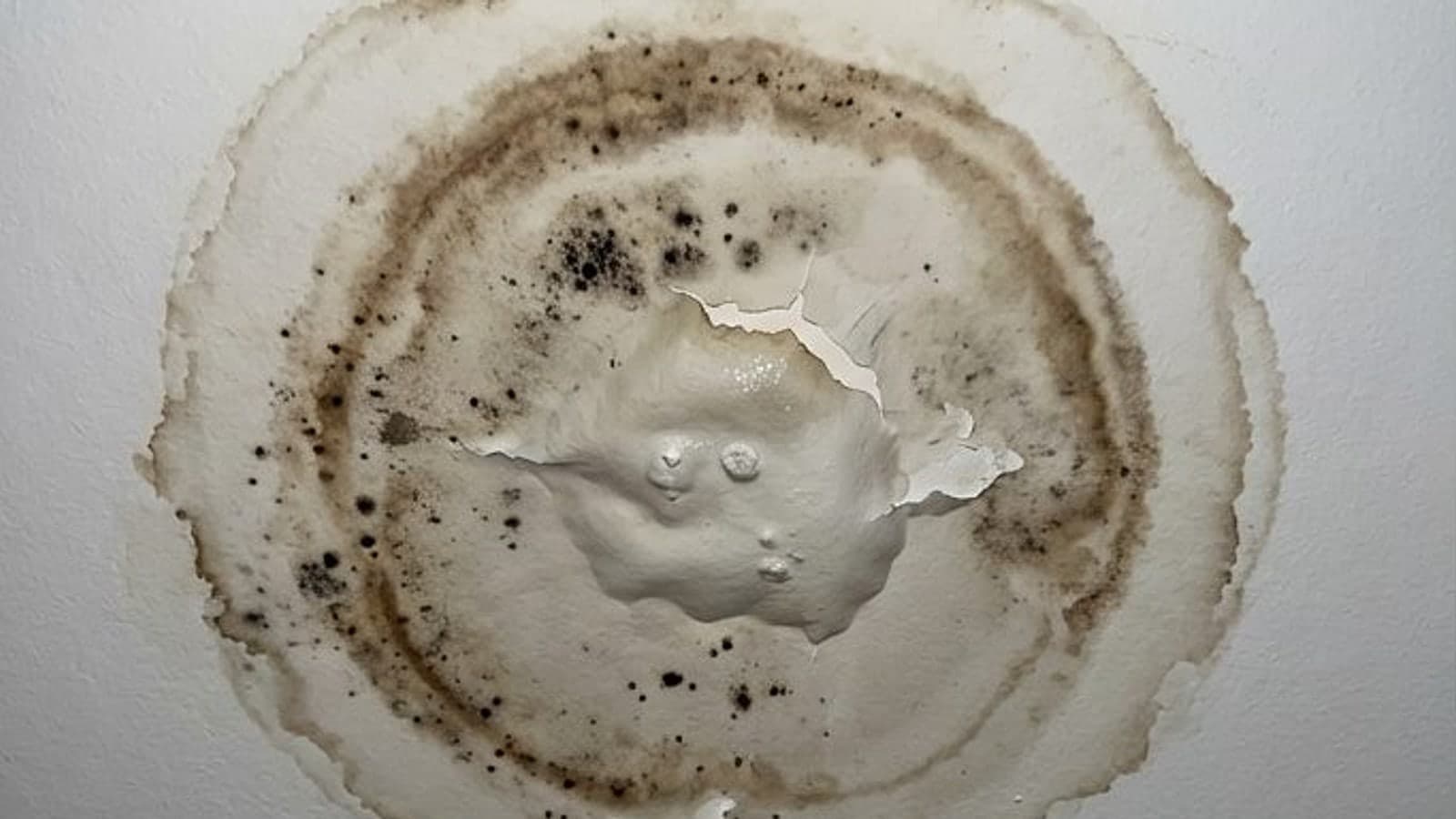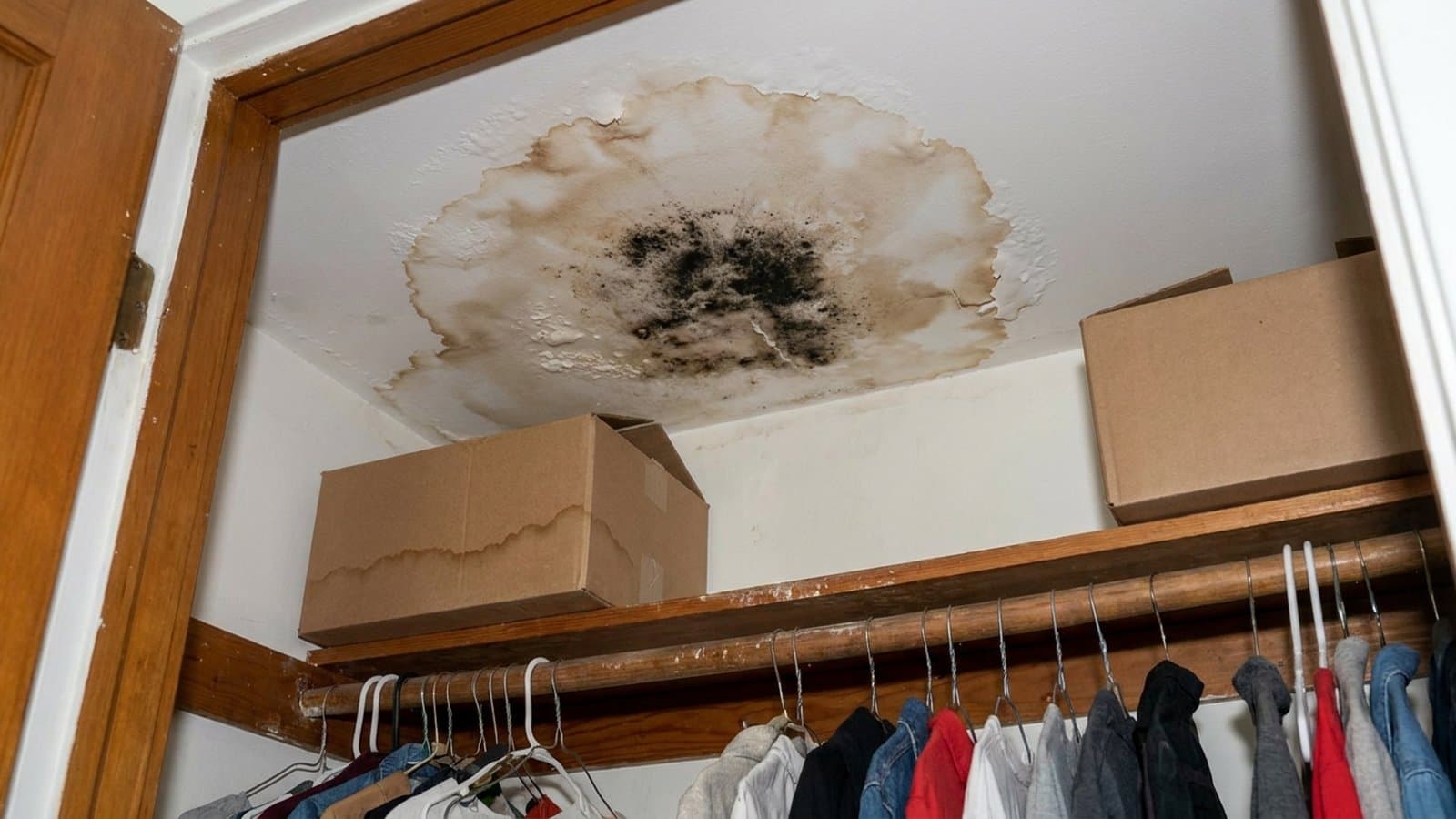
White mold is a description, not a diagnosis. There is no organism called white mold. What people photograph on a basement joist or an attic rafter is a colony that happens to look white, for one of three ordinary reasons: it is young and has not produced pigment yet, it is on a light colored material, or the species does not pigment much at any age.
The species behind it are the same ones behind mold of any color. Aspergillus and Penicillium, the two most common indoor genera in Connecticut, New York, and Massachusetts homes, both routinely appear white or cream before they mature. So color tells you about the age of the colony and the surface it sits on. Moisture tells you about the risk.
The second thing worth knowing is that much of the white growth homeowners find is not mold at all. It is efflorescence, a mineral salt deposit that migrates through masonry and crystallizes on the surface. It is harmless, extremely common in Connecticut basements, and misidentified constantly. Below: how to tell the difference in thirty seconds, where white mold actually grows, and where the line sits between a Saturday job and a containment job.
What Is White Mold, And Can Mold Be White?
Yes, and often. Color comes from pigment produced as a colony matures, so young growth is frequently white regardless of species.
The four white deposits homeowners most often mistake for one another, and the field test that separates them.
White mold
- Looks like
- Fuzzy or cottony, stands off the surface, irregular spreading edge, on wood or drywall or fabric
- Field test
- Spray a little water on it. Mold stays visible and may smear. It does not dissolve.
- What it means
- Active moisture problem. Remove the growth and fix the source.
Efflorescence
- Looks like
- Flat, crystalline, powdery, on bare concrete, block, brick, or stone, often in bands along mortar
- Field test
- Spray a little water on it. It dissolves and disappears, then returns as it dries.
- What it means
- Water is moving through the masonry. Not a health issue, but a moisture signal.
Mildew
- Looks like
- Flat, powdery, gray to white, on tile grout, painted surfaces, and bathroom fixtures
- Field test
- Wipes off with a household cleaner and does not return within days if the room dries out
- What it means
- Surface growth from humidity. Usually a cleaning job, not a remediation job.
Salt or mineral crust
- Looks like
- Hard, gritty, white deposit around a foundation crack or a slab penetration
- Field test
- Does not dissolve readily and feels hard rather than powdery under a fingernail
- What it means
- Long standing water intrusion at a specific point. Trace and seal the entry.
| What it is | Looks like | Field test | What it means |
|---|---|---|---|
| White mold | Fuzzy or cottony, stands off the surface, irregular spreading edge, on wood or drywall or fabric | Spray a little water on it. Mold stays visible and may smear. It does not dissolve. | Active moisture problem. Remove the growth and fix the source. |
| Efflorescence | Flat, crystalline, powdery, on bare concrete, block, brick, or stone, often in bands along mortar | Spray a little water on it. It dissolves and disappears, then returns as it dries. | Water is moving through the masonry. Not a health issue, but a moisture signal. |
| Mildew | Flat, powdery, gray to white, on tile grout, painted surfaces, and bathroom fixtures | Wipes off with a household cleaner and does not return within days if the room dries out | Surface growth from humidity. Usually a cleaning job, not a remediation job. |
| Salt or mineral crust | Hard, gritty, white deposit around a foundation crack or a slab penetration | Does not dissolve readily and feels hard rather than powdery under a fingernail | Long standing water intrusion at a specific point. Trace and seal the entry. |
The Species Usually Behind It
Aspergillus is the most common indoor mold worldwide and appears white to pale yellow-green when young. Penicillium starts white and turns blue-green as it sporulates, which is why a patch seems to change color over a week. Cladosporium can begin pale on a light substrate. None of the three are identified by eye.
What Does White Mold Look Like?
On wood it reads as a fuzzy patch sitting on top of the grain. On drywall it is flatter and powdery. Fuzzy white mold in a basement is nearly always biological. Mold stands off the surface and casts tiny shadows under a raking flashlight, while efflorescence lies flat along mortar lines.
Is White Mold Dangerous?
Color does not grade danger. Area, location, material, and disturbance do.
What The Health Guidance Actually Says
EPA does not rank mold risk by color. EPA notes mold exposure is associated with respiratory symptoms in sensitive individuals, and its guidance is that all indoor growth should be removed regardless of type. EPA does not establish a causal link between mold and specific neurological outcomes. Symptoms belong with a physician.
What Actually Raises The Stakes
Four things, none of them color. Area: EPA guidance uses roughly ten square feet as the threshold above which homeowners should bring in help. Location, because growth beside ductwork distributes spores. Material, since painted masonry differs from porous OSB. And disturbance, because dry brushing a colony releases many spores at once.
The One Thing To Stop Doing Immediately
Do not bleach it. Household bleach is mostly water, and on porous material like framing lumber the water soaks in while the chlorine stays on the surface and evaporates. The visible growth pales, and the moisture that just entered the wood feeds regrowth weeks later. On wood, bleach is the wrong tool.
What Causes White Mold?
Every colony is the visible end of a moisture story. Find the moisture and the question answers itself.
The Only Ingredient You Control
Mold needs spores, food, a temperature range, and moisture. Spores are in every building and cannot be excluded. Food is the building itself. Moisture is the only variable you control, which is why every scope begins and ends with it. Sustained indoor relative humidity above sixty percent supports growth with no liquid water.
What Causes White Mold On Wood Specifically
Wood absorbs and releases moisture with the air around it, and at sixteen percent moisture content it supports growth. That happens three ways: liquid water reaches it, humid air condenses on a surface below the dew point, or it never dried after an earlier event. Condensation is the route people miss.
Where White Mold Grows In A House
Five locations account for nearly everything we are called about, and each has a different fix.
Where white mold appears, what is actually causing it, and what has to change for the removal to hold.
Basement joists and walls
- Usual mechanism
- Summer humid air condensing on year-round cool masonry and framing
- Tell
- General, diffuse growth, worse in July and August, no defined stain edge
- What the durable fix requires
- Humidity held below 55 percent, plus drainage correction if growth follows one wall band
Attic roof sheathing and rafters
- Usual mechanism
- Warm indoor air leaking upward and condensing on the cold deck in winter
- Tell
- Blotchy growth across whole bays, worst on the north slope, no penetration stain
- What the durable fix requires
- Air sealing at the ceiling plane, bath fans ducted outside, corrected intake and exhaust ventilation
Crawl space subfloor and sill
- Usual mechanism
- Continuous evaporation from an exposed dirt floor, made worse by summer venting
- Tell
- Growth on the underside of the subfloor and a damp earth smell at the hatch
- What the durable fix requires
- Sealed ground vapor barrier and controlled humidity, not surface cleaning alone
Raw framing, OSB, plywood
- Usual mechanism
- Wood held near or above 16 percent moisture content long enough to support growth
- Tell
- Fuzzy growth sitting proud of the grain, returns after wiping
- What the durable fix requires
- Moisture content brought down and verified with a meter before anything is sealed or covered
Clothing, upholstery, stored goods
- Usual mechanism
- Weeks of high humidity in a space with no air movement
- Tell
- Pale spotting with a strong musty odor on items against a cool wall
- What the durable fix requires
- Wash and fully dry what is washable, discard what has grown into the fiber, then fix the room
| Location | Usual mechanism | Tell | What the durable fix requires |
|---|---|---|---|
| Basement joists and walls | Summer humid air condensing on year-round cool masonry and framing | General, diffuse growth, worse in July and August, no defined stain edge | Humidity held below 55 percent, plus drainage correction if growth follows one wall band |
| Attic roof sheathing and rafters | Warm indoor air leaking upward and condensing on the cold deck in winter | Blotchy growth across whole bays, worst on the north slope, no penetration stain | Air sealing at the ceiling plane, bath fans ducted outside, corrected intake and exhaust ventilation |
| Crawl space subfloor and sill | Continuous evaporation from an exposed dirt floor, made worse by summer venting | Growth on the underside of the subfloor and a damp earth smell at the hatch | Sealed ground vapor barrier and controlled humidity, not surface cleaning alone |
| Raw framing, OSB, plywood | Wood held near or above 16 percent moisture content long enough to support growth | Fuzzy growth sitting proud of the grain, returns after wiping | Moisture content brought down and verified with a meter before anything is sealed or covered |
| Clothing, upholstery, stored goods | Weeks of high humidity in a space with no air movement | Pale spotting with a strong musty odor on items against a cool wall | Wash and fully dry what is washable, discard what has grown into the fiber, then fix the room |
Basements
A Connecticut basement in summer works like a dehumidifier in reverse: warm humid air gives up moisture onto walls and a slab near ground temperature. White mold on a basement wall, floor, or joist is usually this. Growth along one wall band means bulk water entry. Basement mold remediation begins with that distinction.
Attics And Roof Sheathing
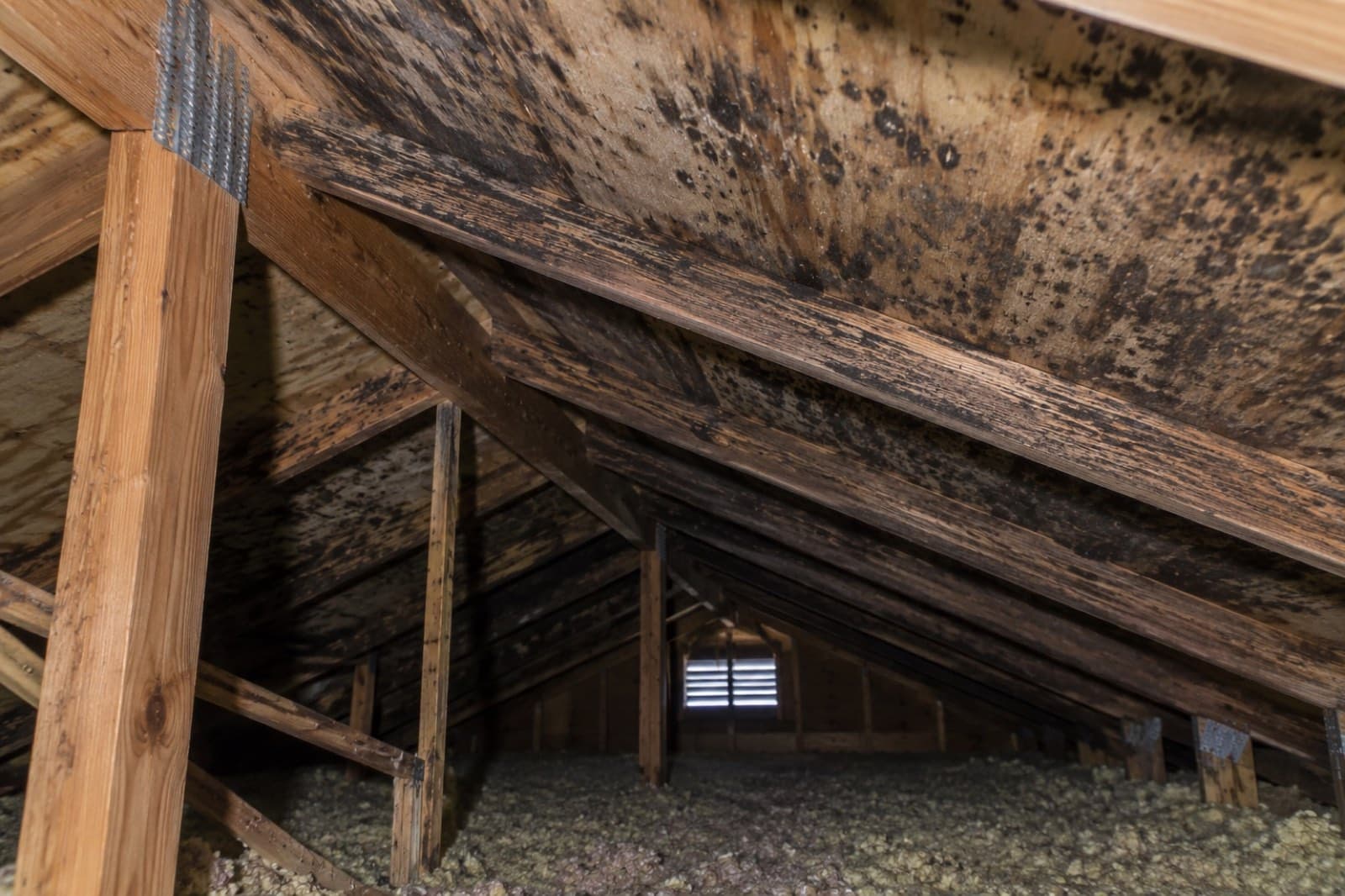
White mold in the attic and on attic rafters is one problem, almost always ventilation and air leakage rather than a roof leak. Indoor air condenses on the cold roof deck, and growth appears first on the north slope. Cleaning without correcting the leakage repeats, so our attic cleanup and insulation work includes sealing.
Crawl Spaces
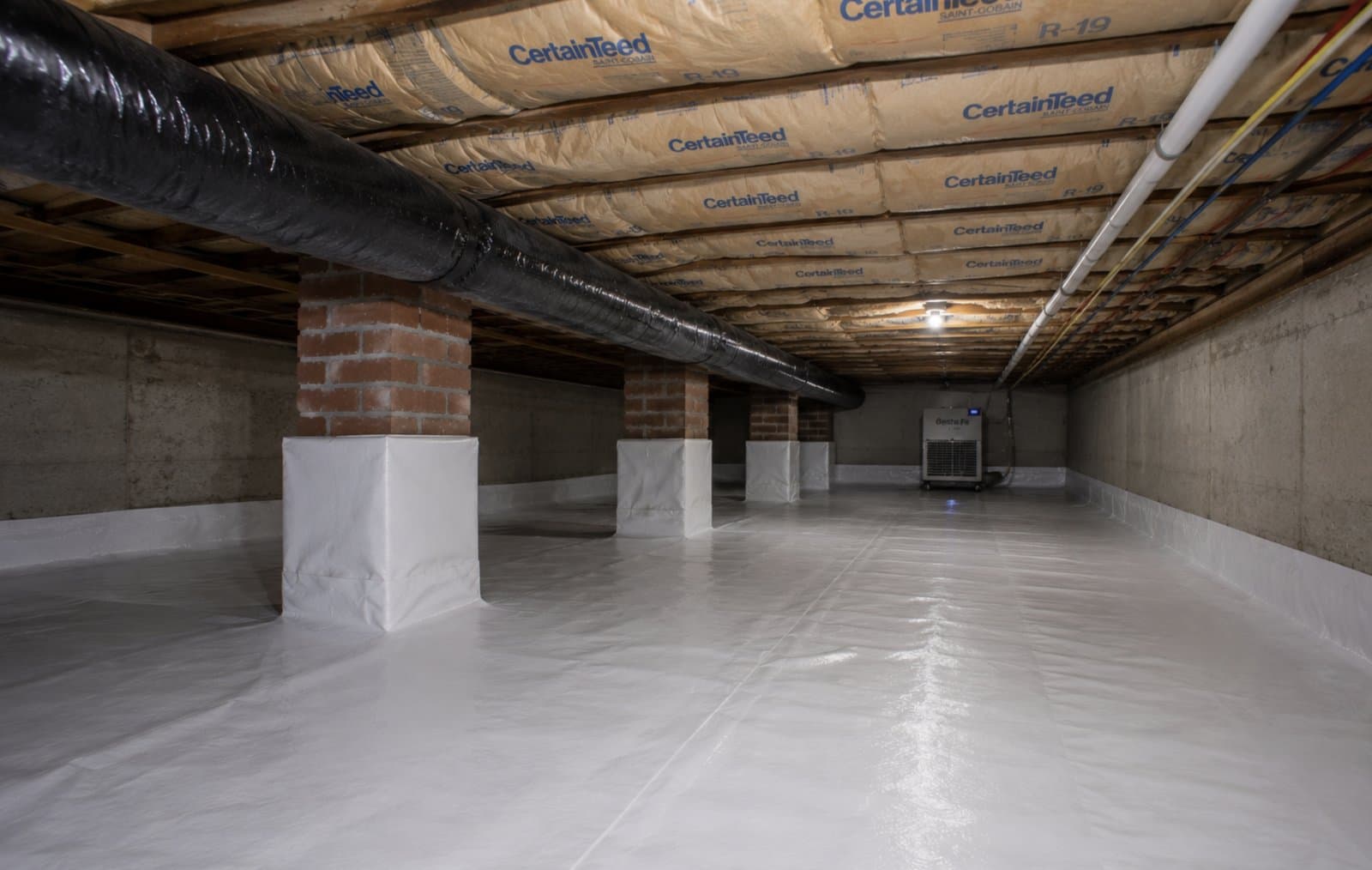
A vented crawl space with an exposed dirt floor evaporates ground moisture into the structure, and in summer the vents make it worse by drawing in humid air. White growth on the subfloor underside and sill is the standard result. The durable fix is a sealed ground vapor barrier and controlled humidity.
Wood Framing, Furniture, And Stored Items
Pictures of white mold on wood are what homeowners send us most, and the distinction is surface versus rooted. On finished, sealed wood the growth sits on the finish and lifts with HEPA vacuuming and a damp cloth. On raw lumber, plywood, and OSB the hyphae penetrate the fiber, so cleaning leaves the colony.
Clothing And Fabric
White mold on clothing is pale spotting with a musty odor, usually on items stored in a basement or an unheated closet. Washable items recover with a hot wash and full drying. Items with growth into the fiber are not worth saving. Growth on textiles means the room held humid air for weeks.
How To Get Rid Of White Mold
The removal is not complicated. Doing it in an order that does not spread spores through the house is the part that takes discipline.
When You Can Do It Yourself
EPA guidance puts the threshold at roughly ten square feet, with a moisture source you have already fixed. Wear an N95, gloves, and eye protection. HEPA vacuum first so you are not aerosolizing spores, then clean with detergent and water or an EPA-registered antimicrobial, not bleach. Recheck the spot in three weeks.
When It Needs Containment
Above ten square feet, on porous material, or near the HVAC system, the work changes character. Under IICRC S520 the area is isolated with sheeting and held under negative air pressure with HEPA filtration, so air flows inward. Porous materials with rooted growth come out, and the space is dried to a documented standard.
What It Costs
In Connecticut and Massachusetts, a small single-area project runs 1,500 to 4,500 dollars, a basement or single room 3,000 to 8,000 dollars, and whole-home 8,000 to 25,000 dollars or more, roughly 14 to 28 dollars per square foot. Derivation is in our mold remediation cost guide, the Stamford mold remediation and Greenwich mold remediation pages, and independent mold inspection and air testing.
"Color tells you how old a colony is and what it is sitting on. Moisture tells you whether it comes back. We have never once written a scope where the color changed the answer."
How Do You Prevent White Mold From Coming Back?
Every recurrence we are called back to has the same cause: the cleaning was completed and the moisture was not.
The Number That Matters
Hold indoor relative humidity between thirty and fifty percent. A cheap hygrometer in the basement and another in the attic will tell you more than any test kit. In a Connecticut summer a basement needs a dehumidifier with a drain. In winter, sealing the air path matters more than adding insulation over it.
The Rest Of The List
Duct bathroom and kitchen fans to the outside, never into the attic or soffit. Keep gutters clear and downspouts discharging away from the foundation. Grade soil away from the house. After any water event, wet materials must be dry within twenty four to forty eight hours, which is what water damage restoration delivers.
Does Insurance Cover White Mold Removal?
It usually depends on what caused the moisture rather than on the mold, and the answer is often no.
The Distinction Carriers Draw
Most homeowners policies treat mold as a consequence rather than a peril. If growth followed a sudden covered event, a burst supply line or a storm-driven roof breach, remediation is frequently covered, often subject to a mold sublimit. If it followed long term humidity, a slow leak, or deferred maintenance, it is excluded.
What We Do And Do Not Do
We document the loss with photographs, moisture readings, and a written IICRC-standard scope, and submit it directly to your insurer so your adjuster evaluates a complete file. We are not licensed public adjusters and do not negotiate claims on your behalf. Coverage decisions belong to your carrier, and your deductible is between you and your insurer.
Need Restoration Services?
60-minute response across CT, NY & MA. Licensed, insured, free inspections.
Questions Homeowners Ask
Can mold be white?+
Yes. Color comes from pigment produced as a colony matures, so many species look white or cream when young. Aspergillus and Penicillium, the two most common indoor genera, both routinely appear white. Color indicates the age of the colony and the surface it grew on, not the hazard.
Is white mold dangerous?+
Color does not grade risk. EPA notes mold exposure is associated with respiratory symptoms in sensitive individuals, and its guidance is that all indoor growth should be removed regardless of type. EPA does not establish a causal link between mold and specific neurological outcomes. Health questions belong with your physician.
How do I tell white mold from efflorescence in my basement?+
Spray a little water on it. Efflorescence is mineral salt and dissolves on contact, returning as the surface dries. Mold does not dissolve and may smear. Mold also stands off the surface under a raking flashlight, while efflorescence lies flat and crystalline on bare concrete, block, and brick.
What causes white mold in a basement?+
Usually humidity rather than a leak. In summer, warm moist outside air meets foundation walls, a slab, and framing that stay near ground temperature all year, so moisture condenses on every cool surface. Sustained relative humidity above roughly sixty percent supports growth with no liquid water in the building.
What causes white mold in an attic?+
Air leakage and ventilation, not usually a roof leak. Warm moist indoor air rises through recessed lights, bath fans terminating in the attic, and gaps around the chimney chase, then condenses on the cold roof deck. Growth appears first on the north slope and spreads across whole bays.
How do you get rid of white mold on wood?+
Below roughly ten square feet, HEPA vacuum first, then clean with detergent and water or an EPA-registered antimicrobial. Do not use bleach on wood: it is mostly water, and it soaks into porous material while the chlorine stays on the surface. Raw lumber with rooted growth needs containment.
Does white mold go away on its own?+
No. Removing the moisture stops a colony growing, and it can go dormant and look inactive, but the material stays colonized and growth resumes when humidity returns. Dead mold is still an allergen and still has to be physically removed. Cleaning without fixing the moisture fails the same way.
How much does white mold removal cost?+
The same as any other color, because scope is set by area and material, not pigment. In Connecticut and Massachusetts a small single-area project runs 1,500 to 4,500 dollars, a basement or single room runs 3,000 to 8,000 dollars, and whole-home projects run 8,000 to 25,000 dollars or more, roughly 14 to 28 dollars per square foot.