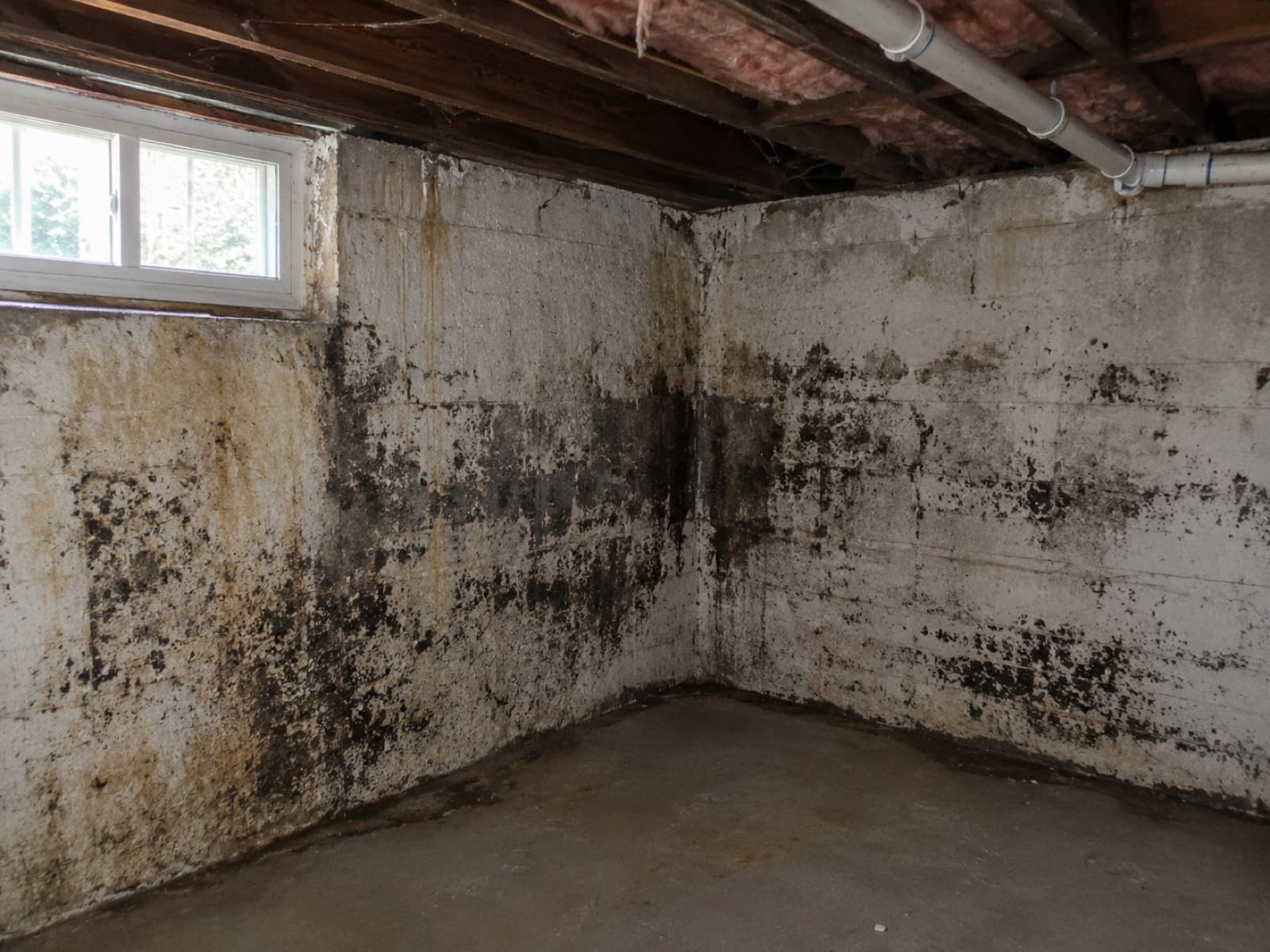
Almost every basement mold call we take traces back to a temperature difference rather than a leak. A foundation wall and a slab sit against soil that stays near fifty five degrees all year. The air in a Connecticut July sits near eighty five degrees carrying a lot of water. Put those two together in one room and liquid water forms on every cold surface, with no plumbing failure anywhere in the building.
That is why so much basement advice fails. Cleaning the wall is not wrong, it is just downstream. Painting the block with a waterproof coating is not wrong either, and it is still downstream. Until the path bringing water into the room is closed, growth returns in the same places, usually behind whatever was stored against the wall and inside whatever was framed over it.
What follows is the five paths in order of how often we find them, the dew point arithmetic that explains why opening the basement windows in summer makes the problem worse, what removal actually involves once growth is on framing, what it costs in Connecticut and Massachusetts, and where insurance usually lands.
Why Does Mold Keep Growing In My Basement?
Because the room is cold, the air is humid, and nothing dries. Two of those three are fixable and the third is the whole job.
Why a Connecticut basement sweats in July and stops in October, using standard dew point figures.
85 degrees and 70 percent humidity
- Dew point of that air
- About 74 degrees
- Typical basement surface
- Slab and lower wall at 62 to 66 degrees
- What happens in the room
- Liquid water forms on the slab, the block, and every cold pipe. The classic July basement
90 degrees and 55 percent humidity
- Dew point of that air
- About 71 degrees
- Typical basement surface
- Block wall near 68 degrees
- What happens in the room
- Condensation on the wall, worst behind stored boxes and inside framed cavities
78 degrees and 65 percent humidity
- Dew point of that air
- About 65 degrees
- Typical basement surface
- Slab near 62 degrees
- What happens in the room
- Marginal. The coolest corners sweat and the rest of the room dries
70 degrees and 45 percent humidity
- Dew point of that air
- About 48 degrees
- Typical basement surface
- Slab near 62 degrees
- What happens in the room
- No condensation at all. This is why opening the windows works in October and backfires in July
| Outdoor air | Dew point of that air | Typical basement surface | What happens in the room |
|---|---|---|---|
| 85 degrees and 70 percent humidity | About 74 degrees | Slab and lower wall at 62 to 66 degrees | Liquid water forms on the slab, the block, and every cold pipe. The classic July basement |
| 90 degrees and 55 percent humidity | About 71 degrees | Block wall near 68 degrees | Condensation on the wall, worst behind stored boxes and inside framed cavities |
| 78 degrees and 65 percent humidity | About 65 degrees | Slab near 62 degrees | Marginal. The coolest corners sweat and the rest of the room dries |
| 70 degrees and 45 percent humidity | About 48 degrees | Slab near 62 degrees | No condensation at all. This is why opening the windows works in October and backfires in July |
The Cold Room Problem
Soil temperature at foundation depth in southern New England stays near fifty five degrees through the year. Concrete and block conduct that temperature straight into the room, so a basement wall and slab remain the coldest surfaces in the house every summer. Warm humid air meeting a cold surface deposits water on it. No leak is required and none of it shows on a water bill.
What The Health Guidance Says
EPA notes mold exposure is associated with respiratory symptoms in sensitive individuals, and its guidance is that indoor growth should be removed along with the moisture supporting it, regardless of color or species. EPA does not recommend routine testing to decide whether to clean. Symptoms belong with a physician rather than with a test kit.
Where Does The Water Actually Come From?
Five paths, and in most houses more than one is open at the same time. Finding which ones decides the entire scope.
The five paths, the pattern each leaves, and what closes it.
Humid outside air
- Pattern in the basement
- General dampness, growth across whole walls and on stored goods
- The tell
- Worst in July and August, better in October with nothing repaired
- What closes it
- Close the windows, run a dehumidifier with a drain, hold 30 to 50 percent
Gutter and grade water
- Pattern in the basement
- A damp band on one section of wall, sometimes with staining at the floor joint
- The tell
- The affected section lines up with a downspout or a low spot outside
- What closes it
- Clear gutters, extend downspouts well away, regrade soil to fall away from the wall
Plumbing or appliance leak
- Pattern in the basement
- A defined wet area, often under or behind one fixture
- The tell
- Growth on the underside of framing or the back of a cabinet before the wall
- What closes it
- Repair the fitting, then dry the assembly before anything is closed back up
Slab vapor
- Pattern in the basement
- Cardboard, carpet pad, and stored paper going musty from the floor up
- The tell
- Tape a square of plastic to the slab overnight. Moisture under it means vapor is coming through
- What closes it
- Get materials off the slab, use a vapor barrier under any finish floor
Rim joist condensation
- Pattern in the basement
- Growth on framing at the top of the foundation, often unseen
- The tell
- Appears in winter, not summer, and smells strongest on cold mornings
- What closes it
- Air seal and insulate the rim joist so indoor air stops reaching cold framing
| Water path | Pattern in the basement | The tell | What closes it |
|---|---|---|---|
| Humid outside air | General dampness, growth across whole walls and on stored goods | Worst in July and August, better in October with nothing repaired | Close the windows, run a dehumidifier with a drain, hold 30 to 50 percent |
| Gutter and grade water | A damp band on one section of wall, sometimes with staining at the floor joint | The affected section lines up with a downspout or a low spot outside | Clear gutters, extend downspouts well away, regrade soil to fall away from the wall |
| Plumbing or appliance leak | A defined wet area, often under or behind one fixture | Growth on the underside of framing or the back of a cabinet before the wall | Repair the fitting, then dry the assembly before anything is closed back up |
| Slab vapor | Cardboard, carpet pad, and stored paper going musty from the floor up | Tape a square of plastic to the slab overnight. Moisture under it means vapor is coming through | Get materials off the slab, use a vapor barrier under any finish floor |
| Rim joist condensation | Growth on framing at the top of the foundation, often unseen | Appears in winter, not summer, and smells strongest on cold mornings | Air seal and insulate the rim joist so indoor air stops reaching cold framing |
Humid Air, Which Is The Most Common
Outside air brought into a cool basement through open windows, a walkout door, or an unbalanced ventilation system. It is the path homeowners least suspect because it feels like fresh air is helping. In July it is the opposite. Every cubic foot of eighty five degree air brought below grade deposits its excess water on the first cold surface it meets.
Roof And Grade Water At The Foundation
Gutters that overflow, downspouts discharging at the wall, and soil graded back toward the house put water directly against the foundation, where it moves through block or through the joint between slab and wall. The tell is that the damp band and the growth follow one section of wall rather than the whole perimeter, and the section usually lines up with a downspout above it.
Plumbing, Appliances, And The Water Heater
A weeping supply fitting, a laundry standpipe that overflows occasionally, a condensate line that has come loose, or a water heater near end of life. This path leaves a defined wet area rather than a general dampness, and it often shows first as growth on the underside of framing or the back of a cabinet rather than on the wall.
Slab Vapor And Rim Joist Condensation
Older slabs poured without a vapor barrier pass ground moisture upward continuously, which is why carpet and stored cardboard on those floors grow before anything else does. Separately, the rim joist at the top of the foundation is where warm indoor air meets cold framing, so it grows in winter rather than summer, hidden above the top of the wall.
"A basement does not have a mold problem. It has a water problem that is expressing itself as mold, and the wall is just where you happen to see it."
How Do You Stop Mold In A Basement?
In the order that actually works, which is outside first, then air, then materials. Cleaning comes last, not first.
Start Outside The House
Clear the gutters and confirm they run when it rains rather than overflowing at a corner. Extend every downspout so it discharges several feet from the wall, not at the splash block. Check that soil falls away from the foundation for the first several feet and that no patio, walk, or planting bed slopes back toward it. This is unglamorous work and it removes more water than any equipment does.
Then Control The Air
Keep basement windows closed from late spring through early autumn. Run a dehumidifier sized for the space with a hose to a drain or a pump, and set it to hold thirty to fifty percent. Put a hygrometer where you can read it. If the unit runs constantly and never reaches setpoint, air is arriving from somewhere, usually a window, a bulkhead, or an unsealed rim joist.
How Is Basement Mold Removed?
Below roughly ten square feet on a hard surface it is a homeowner job. Above that, or on framing, the work changes character.
What You Can Do Yourself
EPA guidance puts the homeowner threshold at roughly ten square feet, with the moisture source already corrected. Wear an N95, gloves, and eye protection. HEPA vacuum first so you are not aerosolizing anything, then clean with detergent and water rather than bleach, which drives water into porous material. Dry the surface fully, then check the same area three weeks later.
What Professional Removal Involves
Above that threshold, or where growth is on framing, subfloor, or the back of finished walls, work follows IICRC S520. The area is isolated with sheeting and held under negative air pressure with HEPA filtration so air flows into the containment rather than out of it. Porous material with rooted growth is removed rather than treated, the cavity is dried to a documented standard, and the space is HEPA cleaned before rebuild.
The Finished Basement Complication
A finished basement hides the two surfaces that matter, the back of the drywall and the face of the foundation, and growth there is often found only when a baseboard comes off. Any finished basement with a persistent musty smell and no visible growth needs the wall opened at the worst-smelling corner. That single inspection cut is far cheaper than discovering the extent two years later.
What Does Basement Mold Removal Cost, And Does Insurance Cover It?
Real Connecticut and Massachusetts numbers, and the coverage distinction that decides most claims.
The Numbers
A small single-area project runs 1,500 to 4,500 dollars, a basement or single room runs 3,000 to 8,000 dollars, and whole-home work runs 8,000 to 25,000 dollars or more, roughly 14 to 28 dollars per square foot. Most residential basements land in the middle band. The full derivation, including what moves a job inside its range, is in our mold remediation cost guide.
When The Basement Flooded First
If water arrived as an event rather than as humidity, the water work comes first and is priced separately. Clean water runs 1,500 to 4,500 dollars, gray water 2,500 to 8,500 dollars, and category three water including sewage runs 7,500 to 50,000 dollars or more. Those tiers and what separates them sit in our water damage cost guide, with the work itself described on our water damage restoration and sewage cleanup pages.
The Coverage Line Carriers Draw
Most homeowners policies treat mold as a consequence rather than a peril. Growth that followed a sudden covered event, a burst supply line or a storm-driven breach, is frequently covered, often subject to a mold sublimit. Growth that followed years of summer humidity, a slow leak, or deferred gutter maintenance is usually excluded. We document the loss with photographs, moisture readings, and a written scope, and submit it directly to your insurer. We are not licensed public adjusters and do not negotiate claims on your behalf.
Where To Start If You Are Not Sure
A visual assessment settles most basements, and where extent is genuinely unclear, independent mold inspection and air testing produces lab results rather than an opinion. The removal scope itself is described on our mold remediation page and locally on pages such as Bridgeport mold remediation. If the same house has a dirt crawl space feeding the basement, our crawl space cleanup page covers that half of the problem.
Need Restoration Services?
60-minute response across CT, NY & MA. Licensed, insured, free inspections.
Questions Homeowners Ask
Why does my basement smell musty even though I cannot see mold?+
Because the growth is usually behind something. The two surfaces that matter in a basement are the back of finished drywall and the face of the foundation, and neither is visible in a finished room. A persistent musty smell with nothing on show is the standard reason to pull a baseboard at the worst-smelling corner and look.
Should I open basement windows to dry it out?+
Not in summer. Air at eighty five degrees and seventy percent humidity has a dew point near seventy four degrees, and a basement slab sits in the low sixties, so that air deposits liquid water on every surface it reaches. Ventilating a basement with outdoor air helps in autumn and makes things measurably worse in July.
Will a dehumidifier stop basement mold on its own?+
It stops growth caused by humid air, which is the most common path, provided it is sized for the space, drains continuously, and actually holds thirty to fifty percent. It does nothing about gutter water at the foundation, a plumbing leak, or vapor coming up through an uncovered slab, and those paths have to be closed separately.
Is mold on basement joists and subfloor serious?+
It changes the scope, because framing and sheathing are porous and growth roots into the grain rather than sitting on it. Surface cleaning does not reach it, so joists and subfloor generally require containment, HEPA filtration, and abrasive removal under IICRC S520 rather than a wipe-down.
How much does it cost to remove mold from a basement?+
In Connecticut and Massachusetts a basement or single-room project typically runs 3,000 to 8,000 dollars, with small isolated areas at 1,500 to 4,500 dollars and whole-home work at 8,000 to 25,000 dollars or more, roughly 14 to 28 dollars per square foot. Area, material, and access set the position inside those bands.
Can I finish a basement that has had mold?+
Yes, once the water paths are closed, the affected material is removed, and the space holds thirty to fifty percent humidity through a full summer. Finishing over an unresolved moisture path is the single most expensive mistake in this category, because the new framing and drywall become the growth surface and it is invisible until it smells.
Does waterproof paint on the foundation stop mold?+
It can slow moisture passing through block, and it does not address air that condenses on the wall, water arriving from a downspout, or vapor rising through the slab. Coatings applied to a wall that is still taking on water often blister and peel, which is why the outside work and the humidity control come first.
Is basement mold covered by homeowners insurance?+
It typically depends on the cause of the moisture rather than on the mold. A sudden covered event such as a burst pipe is frequently covered, often with a mold sublimit, while long term humidity or a slow leak is usually excluded. Coverage decisions belong to your carrier under your policy.